 HoldMyTwist
How to choose a power bank you can fly with
As of 27th March 2026, ICAO regulations came into force that allow you to carry up to 2 powerbanks per person. The regulations also state that it is not permitted to recharge powerbanks onboard. Countries apply these regulations in different ways, so before travelling make sure to check with the airline rules.
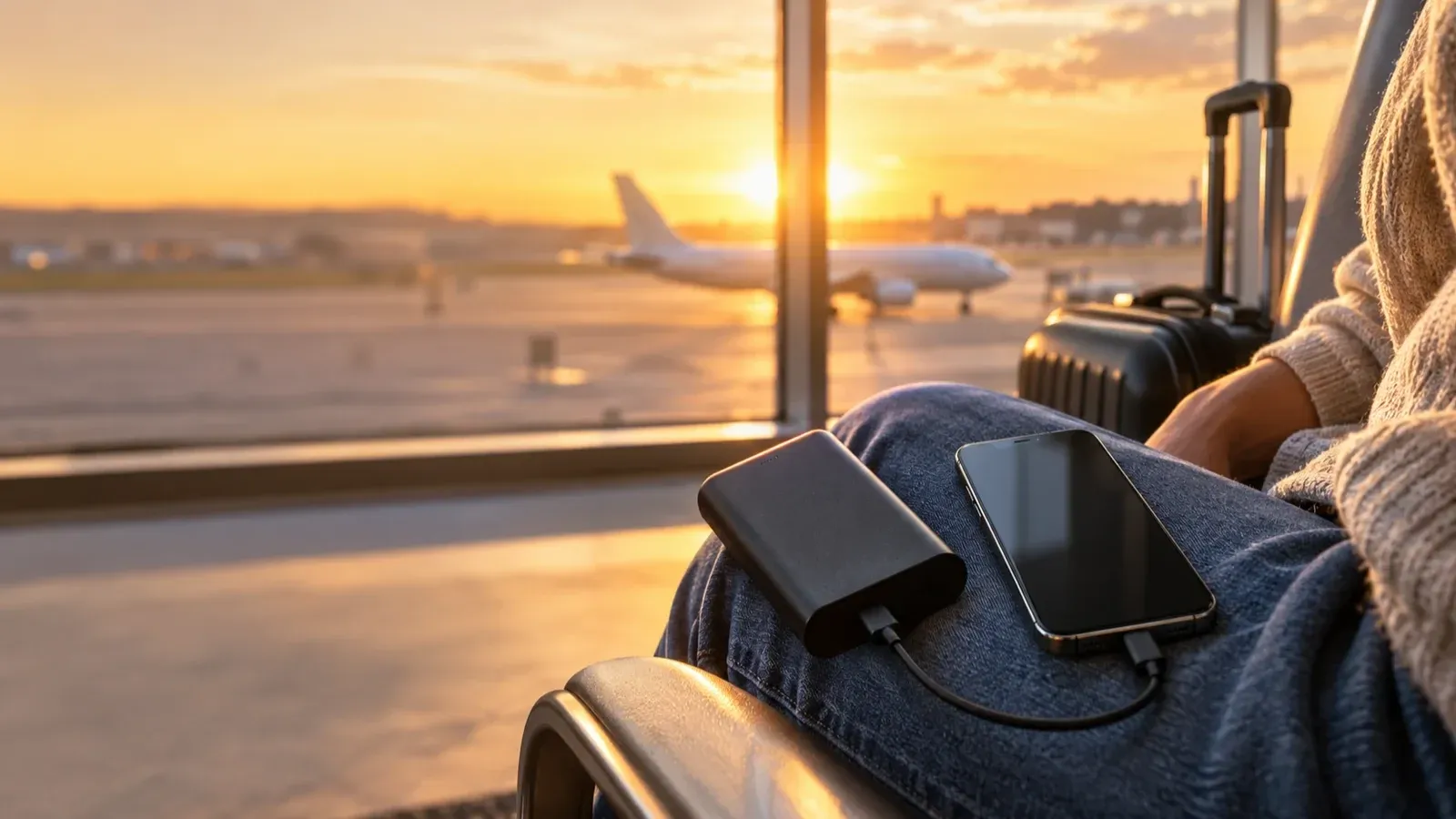
Some airlines restrict this even more. You can only bring one. And according to IATA, from 1 January 2027 they prohibit power banks above 100 Wh.
We didn't purchase or review these power banks. We use manufacturer spec pages, regulators in the aviation industry and recall databases for this guide. What follows below are only examples of where you can find these numbers. None of these are recommendations.
1. Find the watt-hours
Airlines rate things by watt-hours (Wh). You'll probably see milliamp-hours (mAh) on the box. According to IATA, lithium ion batteries must be labelled with their Wh rating on the outside of the battery. The airline can reject a battery if it cannot verify it.
- If you can see Wh on the box or case or spec page then do that.
- If you only see mAh then take that and multiply by the nominal battery voltage given for that capacity, then divide by 1000. Not the USB output voltage. See formula below from Civil Aviation Safety Authority of Australia (CASA).
Most powerbanks run on cell at 3.6/3.7v or so. 10k mAh is ~37 Wh power bank. 20k mAh is ~72-74 Wh power bank. E.g. 72Wh for ugreen's 20k mAh Nexode. Iniu puts 74Wh for 20k mAh carry
2. Check the 100 Wh limit
UK Civil Aviation Authority states no need for airline approval for power banks up to and including 100Wh as long as you follow their packing rules. Below is what CASA says as well which includes power banks up to 100Wh. Check with your airline for limits.
- Keep it with your carry-on. No major regulator permits spare power bank in checked baggage. Per US FAA, if checking bag at gate - remove it.
- Care for the ends. If in retail package, keep in that, or if terminals exposed, tape them up, or have own pouch, etc.
- Don't take power banks > 100 Wh. At least for now, UK CAA requires approval by airline for >100 Wh and <=160 Wh. On 1/1/2027, per IATA, power bank >100 Wh (and <=160 Wh) will be prohibited. No power bank > 160 Wh may be in passenger's baggage.
"Flight safe" or "airline approved" labels don't excuse you from checking watt-hours on case, current baggage policy for your airline and any necessary approval. < 100 Wh does not exempt you from packing and use restrictions onboard.
3. Check usable capacity
The mAh you see on box typically refers to the cells. It's not a like for like comparison between rated output capacity at 5 volts to the capacity of a cell at 3.6 or 3.7 volts. There is some loss in power bank and in charging of your phone. For example, UGREEN claims its 20,000mAh Nexode has a rated output capacity of 11,300mAh at 5 volts. UGREEN claims its 10,000mAh magnetic has a rated output capacity of 6,250mAh at 5 volts. (It's not a capacity of what you have on your phone, it's a capacity rating of what it's outputting). So
- You should look at the phone's battery size on the manufacturer spec page.
- Anker gives an estimate of how many times you can charge your phone by multiplying 10000 (for its 10000mAh Zolo) by 0.65, then divide by mAh of phone battery. This is for Anker's guesstimate for that particular model, it's not a rule of thumb for converting in general (device/conditions will affect your actual results).
Watch out
Look at the case for how many watt-hours it is. Look up your airline's current rules. Always have a legal power bank in carry on, with your terminals covered. Look up the specific model for any recalls. An "it's flight safe" sticker is not carte blanche by your airline.
4. Match the output to your devices
The output (watts W). It's the max power a port can deliver. Make sure your device, cable and charging standard are compatible.
- Phones. See the spec page of your phone's maker. How much fast charging wattage is it? Phone requires far less power than laptop.
- Laptops. Check if your laptop can be charged via USB-C PD power delivery. Then find a compatible power bank and cable that match the voltage and wattage required by the laptop maker. Anker 20,000 mAh. The one with a built-in cable can deliver 65W from the cable and its USB-C port. The UGREEN 20,000 mAh Nexode can deliver 100W from a single port.
- Multiple devices. See the total output when multiple ports are used. INIU 10,000 mAh 45W. Total output will only be 15W when using two or three ports.
- Earbuds and watches. Some power banks may power off when the device consumes very little power. See if it has low-current (trickle) mode. UGREEN, INIU lists it on some models. Weight, and recharging time. 20,000 mAh ones have 313-431 g, according to the makers. 10,000 mAh ones have 182-220 g. UGREEN says it takes ~3.5 hours to recharge its 10,000 mAh magnetic power bank with a 20W charger.
5. Check your airline's own rules
Some airlines can be more conservative than the regulators. Many are. Here's what you'll find on the individual airline/regulator websites. Rules may change. Always check your airline website before flying.
- UK Civil Aviation Authority: Max 2 for each passenger. No recharging.
- Emirates: Only 1 power bank < 100Wh. No usage, no charging on board. Keep in seat pocket or under seat. Not in overhead bin.
- Singapore Airlines, Cathay Pacific, Qantas, Jetstar, Virgin Australia: Max 2 power banks. No usage, no charging on board. Also no overhead locker (for SQ, CX, VA).
- China domestic flights: (From Singapore Airlines page.) As of 28 June 2025, No power bank without clear 3C certificate mark is allowed on domestic flights in China. (From UGREEN page for 20000 mAh Nexode) No allowance on flights within China.
- Check your airline website for 'power bank' or 'lithium battery' before every flight.
- Bring the power bank at accessible range (e.g. seat pocket or under the front seat).
6. Check the model for recalls
In 2025-2026, many major brands had to recall their power banks because they could get too hot and burst into flames. Virgin Australia won't let you bring recalled power banks onto their flights.
- Locate the model number on your power bank's back or on the specs page.
- Use the model number or "power bank" in a search of your country's recall database (US: Consumer Product Safety Commission (CPSC); UK: product safety alerts; Product Safety Australia).
- If your model is included you need to stop using it and follow the recall instructions to get a refund or replacement. Do not dispose of it in the household garbage.
If your power bank swells, gets hot or smells
Don't use it / don't charge it. Only turn it off if it's safe to do so. (Just because you CAN disconnect power doesn't mean it's safe to do so). If it catches fire / is smoking at home, get out, call for help (opens in a new tab) (000 in Aus). Don't touch it. For a damaged / bulging battery, contact your local council / approved recycler for how to safely move / dispose of it (opens in a new tab). Don't put it in your household garbage / recycling bin or a regular battery drop off box.
On a flight, tell cabin crew immediately. CASA recommends carrying spare batteries in the cabin for the crew to address the issue quickly.
Sources: IATA, Passengers travelling with lithium batteries (opens in a new tab) and Guidance to operators on power banks (opens in a new tab); CASA, Lithium batteries (opens in a new tab) and Power bank not exceeding 100 Wh (opens in a new tab); FAA, Lithium batteries (opens in a new tab); UK CAA, What to pack (opens in a new tab); Emirates (opens in a new tab), Singapore Airlines (opens in a new tab), Cathay Pacific (opens in a new tab), Qantas (opens in a new tab), Jetstar (opens in a new tab) and Virgin Australia (opens in a new tab); manufacturers' pages for Anker A1688 (opens in a new tab), Anker A1383 (opens in a new tab), UGREEN Nexode 20000mAh (opens in a new tab), UGREEN magnetic 10000mAh (opens in a new tab), INIU Carry 20000mAh (opens in a new tab) and INIU 10000mAh 45W (opens in a new tab); recalls at CPSC (opens in a new tab), UK product safety alerts (opens in a new tab) and Product Safety Australia (opens in a new tab). The CASA screenshots are cropped from CASA's pages, used under CC BY 4.0 (opens in a new tab).
Additional sources: Anker, Rated capacity explained (opens in a new tab); Microsoft, USB-C charging requirements (opens in a new tab).
Share this post
From holdmytwist.com/blog/choose-a-power-bank-you-can-fly-with/
Related posts
Find cheaper flights with Google Flights

Compare dates you are flexible, account for baggage fees, and look into booking options before you fly.