 HoldMyTwist
How to choose a power bank you can fly with
Rules introduced by the International Civil Aviation Organization on 27 March 2026 limit passengers to two power banks and prohibit recharging them on board; implementation depends on the country. Check your airline's rules before flying. Read watt-hours, usable capacity and output, and check for recalls.
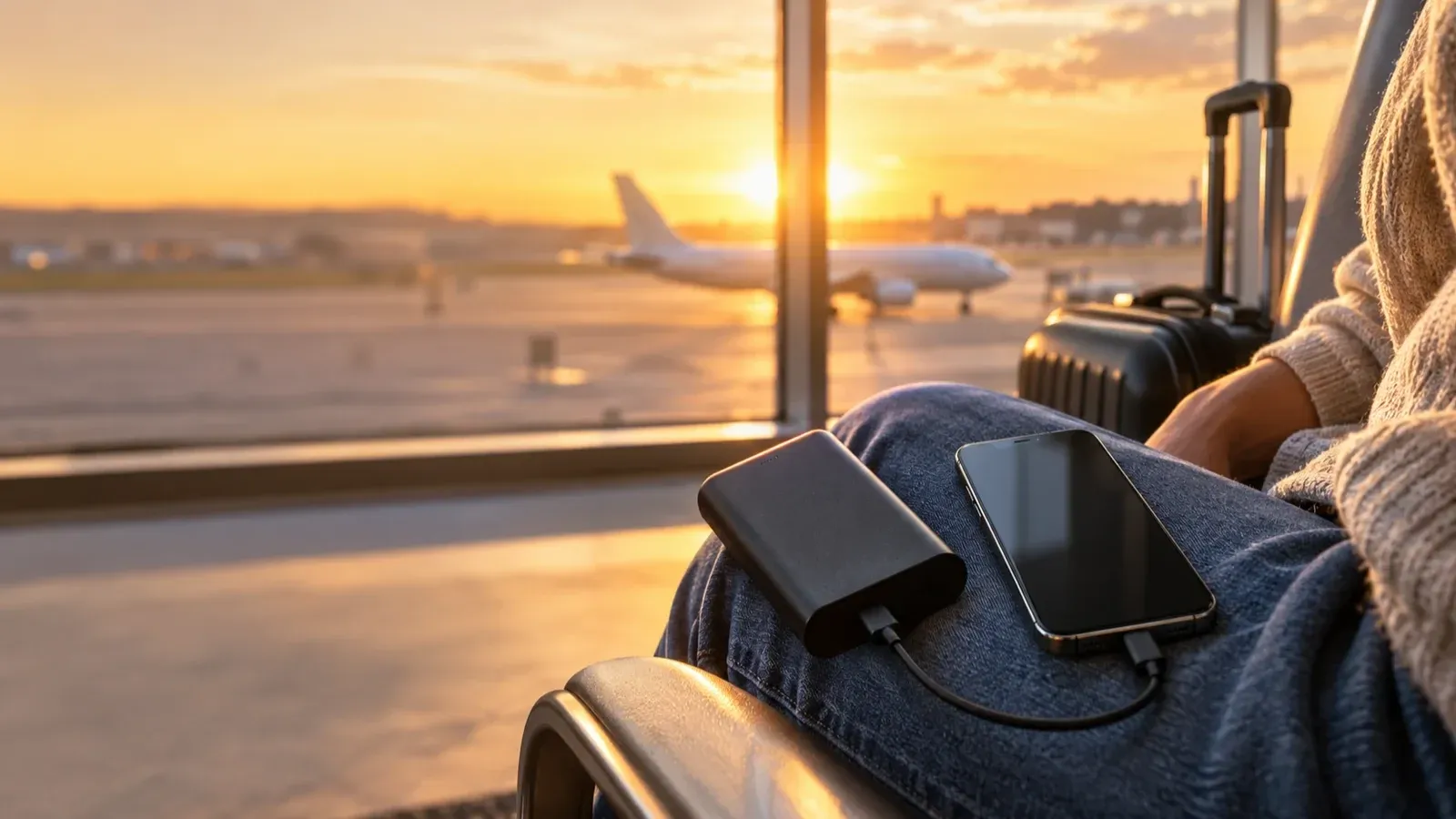
Some airlines go further and allow only one. IATA's guidance also lists power banks over 100 Wh as forbidden from 1 January 2027.
We haven't bought or tested these power banks. This guide uses manufacturers' spec pages, aviation regulators and recall databases. The models named below only show where to find each number. They are not recommendations.
1. Find the watt-hours
Airlines set their limits in watt-hours (Wh), and the box usually shows milliamp-hours (mAh). IATA says lithium-ion batteries must have the Wh rating marked on the outside, and that an airline may refuse one it can't check.
- Look for Wh on the case, the box or the spec page.
- If you can only find mAh, multiply it by the nominal battery voltage stated for that capacity and divide by 1,000. Do not use the USB output voltage. Australia's Civil Aviation Safety Authority (CASA) gives the formula below.
Most power banks use cells of about 3.6 or 3.7 volts. A 10,000 mAh power bank comes to about 37 Wh, and a 20,000 mAh one to about 72 to 74 Wh. UGREEN lists 72 Wh for its 20,000 mAh Nexode, and INIU lists 74 Wh for its 20,000 mAh Carry.
2. Check the 100 Wh limit
The UK Civil Aviation Authority allows power banks up to and including 100 Wh without airline approval, subject to its packing rules. CASA's guidance below also covers power banks up to 100 Wh. Check your airline's limits before flying.
- Pack it in your carry-on bag. No major regulator allows a spare power bank in checked luggage, and the US FAA says to take it out if your bag is checked at the gate.
- Protect the ends. Keep it in its retail packaging, tape over exposed terminals or put it in its own pouch.
- Avoid power banks above 100 Wh. The UK CAA currently requires airline approval for those above 100 Wh and up to 160 Wh; from 1 January 2027 IATA lists that size as forbidden. Power banks over 160 Wh are not allowed in passenger baggage.
Labels such as "flight safe" or "airline approved" do not replace checking the watt-hours on the case, your airline's current baggage rules and any required approval. A capacity below 100 Wh does not remove the packing and on-board use restrictions.
3. Check usable capacity
The mAh on the box usually describes the cells. A rated output capacity measured at 5 volts is not directly comparable with cell capacity measured at 3.6 or 3.7 volts. Some energy is also lost in the power bank and while charging your phone.
UGREEN lists a rated output capacity of 11,300 mAh at 5 volts for its 20,000 mAh Nexode, and 6,250 mAh at 5 volts for its 10,000 mAh magnetic model. These are output ratings, not the amount stored in your phone.
- Check your phone's battery size on its maker's spec page.
- For its 10,000 mAh Zolo, Anker estimates phone charges by multiplying 10,000 by 0.65 and dividing by the phone battery's mAh. Treat this as Anker's rough estimate for that model, not a general conversion rule; actual results depend on the device and charging conditions.
Watch out
Read the watt-hours on the case and check your airline's current rules before each trip. Keep a permitted power bank in carry-on baggage with its terminals protected. Check the exact model for recalls; a "flight safe" label is not permission from your airline.
4. Match the output to your devices
The output in watts (W) is the maximum power a port can supply. Your device, cable and charging standard must also be compatible.
- Phones. Check the fast-charging wattage on your phone maker's spec page. A phone needs far less than a laptop.
- Laptops. First check that your laptop supports charging over USB-C Power Delivery (PD). Choose a compatible power bank and cable that meet the laptop maker's voltage and wattage requirements. Anker's 20,000 mAh model with a built-in cable gives 65 W from the cable or its USB-C port. UGREEN's 20,000 mAh Nexode gives 100 W from one port.
- Several devices at once. Check the total output when several ports are in use. INIU's 10,000 mAh 45 W model drops to 15 W in total when two or three ports are in use.
- Earbuds and watches. Some power banks switch off when the device draws very little power. Look for a low-current or trickle mode, which UGREEN and INIU both list on some models.
Check the weight and recharge time too. Makers list 313 to 431 g for the 20,000 mAh models above, and 182 to 220 g for the 10,000 mAh ones. UGREEN quotes about 3.5 hours to recharge its 10,000 mAh magnetic model with a 20 W charger.
5. Check your airline's own rules
Airlines can be stricter than the regulators, and many are. These rules come from each airline's or regulator's own page. Rules change, so check your airline's page before you fly.
- UK Civil Aviation Authority. At most two power banks per person, and no recharging them on board.
- Emirates. One power bank under 100 Wh. You can't use or charge it on board, and it goes in the seat pocket or under the seat, not the overhead bin.
- Singapore Airlines, Cathay Pacific, Qantas, Jetstar and Virgin Australia. Two at most, and no using or charging them during the flight. Singapore Airlines, Cathay Pacific and Virgin Australia also say not to put them in the overhead locker.
- Flights within China. Singapore Airlines' page says that since 28 June 2025, power banks without a clear 3C certification mark aren't allowed on domestic flights in China. UGREEN's page for its 20,000 mAh Nexode says it can't be carried on Chinese flights.
- Search your airline's site for "power bank" or "lithium battery" before each trip.
- Keep the power bank where you can reach it, usually the seat pocket or under the seat in front.
6. Check the model for recalls
Several big brands recalled power banks in 2025 and 2026 because they could overheat and catch fire. Virgin Australia doesn't allow recalled power banks on board at all.
- Find the model number on the back of the power bank or on its spec page.
- Search for "power bank" or the model number in the recall database for your country: the US Consumer Product Safety Commission (CPSC), the UK's product safety alerts, or Product Safety Australia.
- If your model is listed, stop using it and follow the recall's instructions for a refund or replacement. Don't throw it in the household bin.
If your power bank swells, gets hot or smells
Stop using or charging it, and disconnect power only if safe. If it smokes or burns at home, leave the area and call emergency services (opens in a new tab) (000 in Australia). Do not handle it. For a damaged or swollen battery, ask your local council or an approved recycler for safe handling and disposal instructions (opens in a new tab) before moving it. Do not put it in household rubbish, household recycling or an ordinary battery drop-off bin.
On a plane, tell the cabin crew straight away. CASA's advice is to keep spare batteries in the cabin so crew can deal with a problem quickly.
Sources: IATA, Passengers travelling with lithium batteries (opens in a new tab) and Guidance to operators on power banks (opens in a new tab); CASA, Lithium batteries (opens in a new tab) and Power bank not exceeding 100 Wh (opens in a new tab); FAA, Lithium batteries (opens in a new tab); UK CAA, What to pack (opens in a new tab); Emirates (opens in a new tab), Singapore Airlines (opens in a new tab), Cathay Pacific (opens in a new tab), Qantas (opens in a new tab), Jetstar (opens in a new tab) and Virgin Australia (opens in a new tab); manufacturers' pages for Anker A1688 (opens in a new tab), Anker A1383 (opens in a new tab), UGREEN Nexode 20000mAh (opens in a new tab), UGREEN magnetic 10000mAh (opens in a new tab), INIU Carry 20000mAh (opens in a new tab) and INIU 10000mAh 45W (opens in a new tab); recalls at CPSC (opens in a new tab), UK product safety alerts (opens in a new tab) and Product Safety Australia (opens in a new tab). The CASA screenshots are cropped from CASA's pages, used under CC BY 4.0 (opens in a new tab).
Additional sources: Anker, Rated capacity explained (opens in a new tab); Microsoft, USB-C charging requirements (opens in a new tab).
Share this guide
From holdmytwist.com/guides/choose-a-power-bank-you-can-fly-with/
Related guides

Find cheaper flights with Google Flights
Compare flexible travel dates, include baggage costs and check booking arrangements before choosing a flight.
In this guide