 HoldMyTwist
Episode 49
The Bell That Favoured Four
Duck thinks there is something rigged with a bell game. Duck is playing with 2 spinners, each with 1, 2 and 3 (equal chance). Neither spinner influences the other. This gives 9 possible outcome pairs, all equally likely.
Episode transcript
A suspicious bell
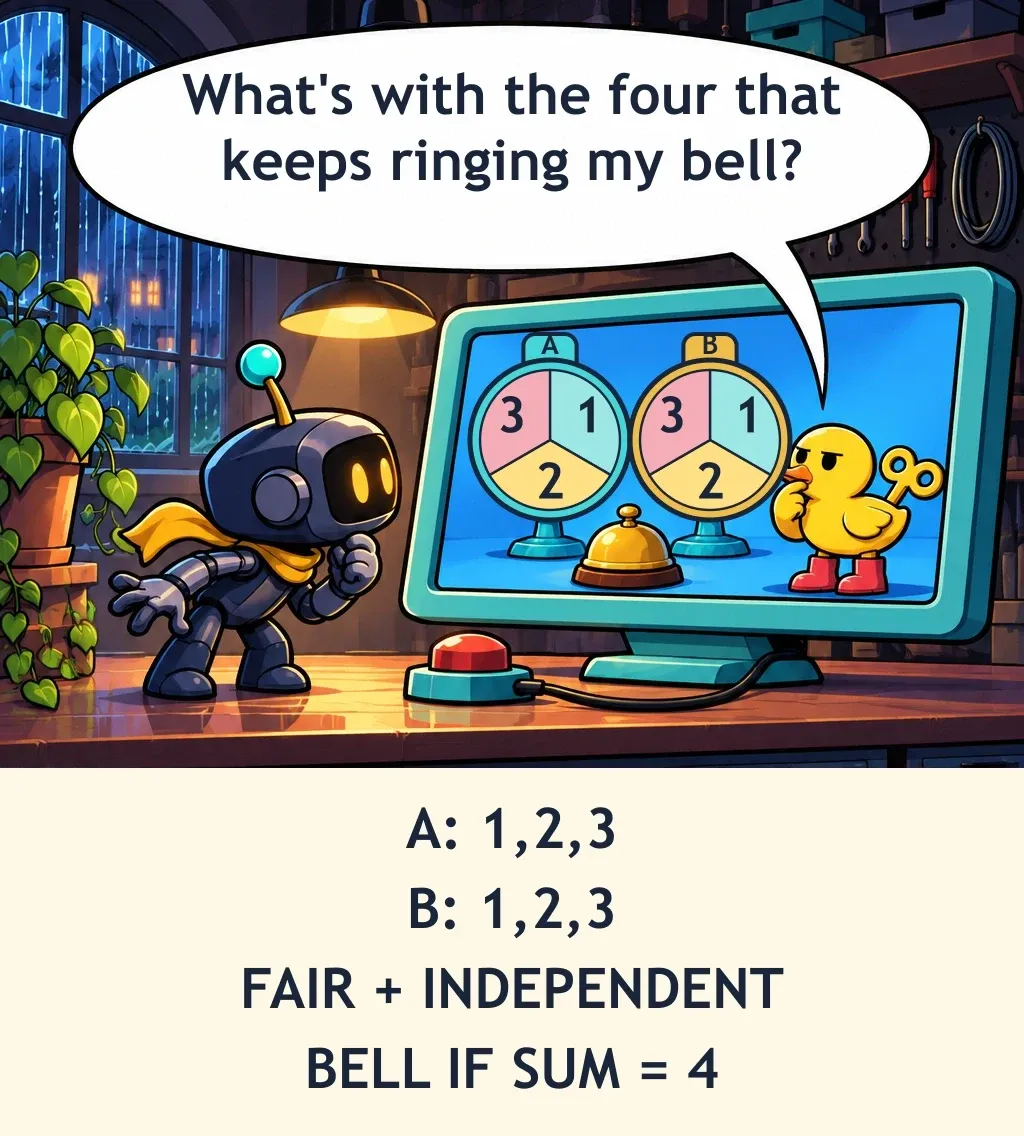
Duck is on the monitor behind 2 spinners and a brass bell. Robot is on the outside of the monitor, leaning into the game. Each of the spinners has three equal sectors.
Diagram values: A: 1,2,3; B: 1,2,3; FAIR + INDEPENDENT; BELL IF SUM = 4
Duck: What's with the four that keeps ringing my bell?
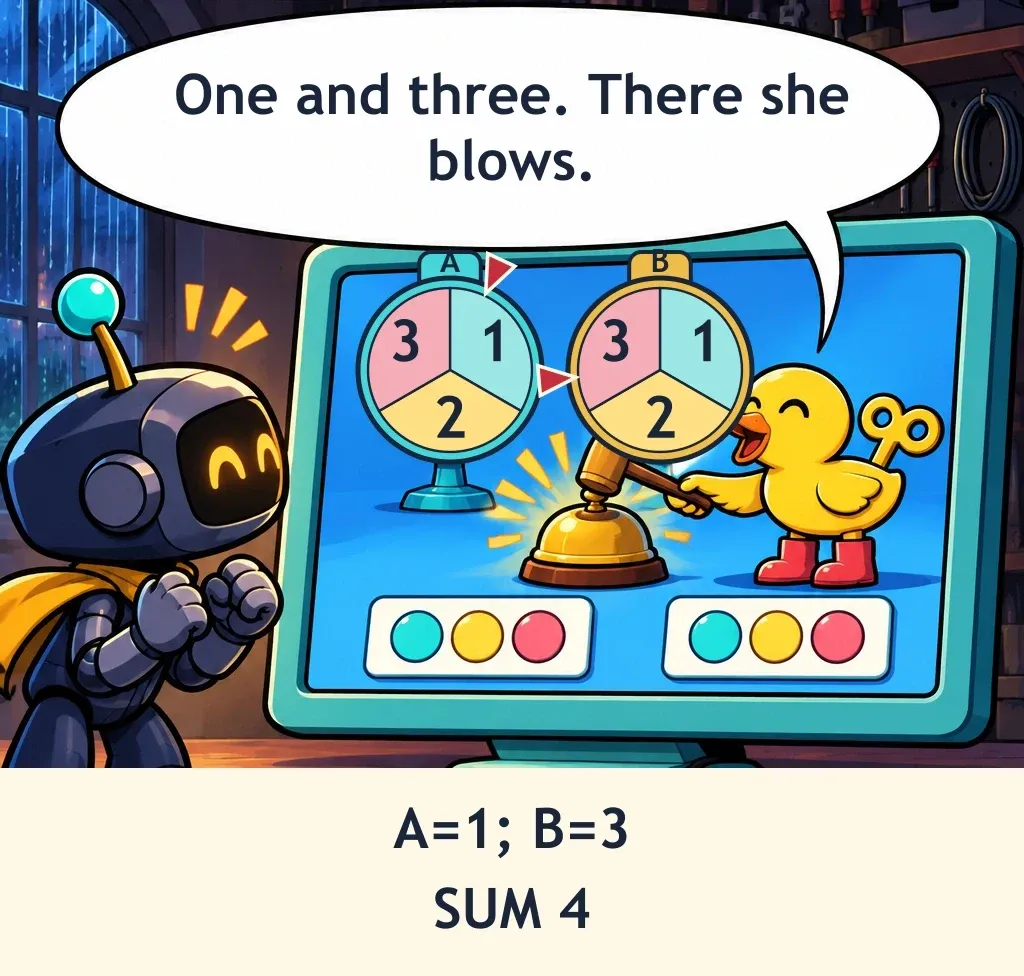
Duck spins separate aqua and gold. Aqua is on one. Gold is on three. Duck rings bell for four.
Diagram values: A=1; B=3; SUM 4
Duck: One and three. There she blows.
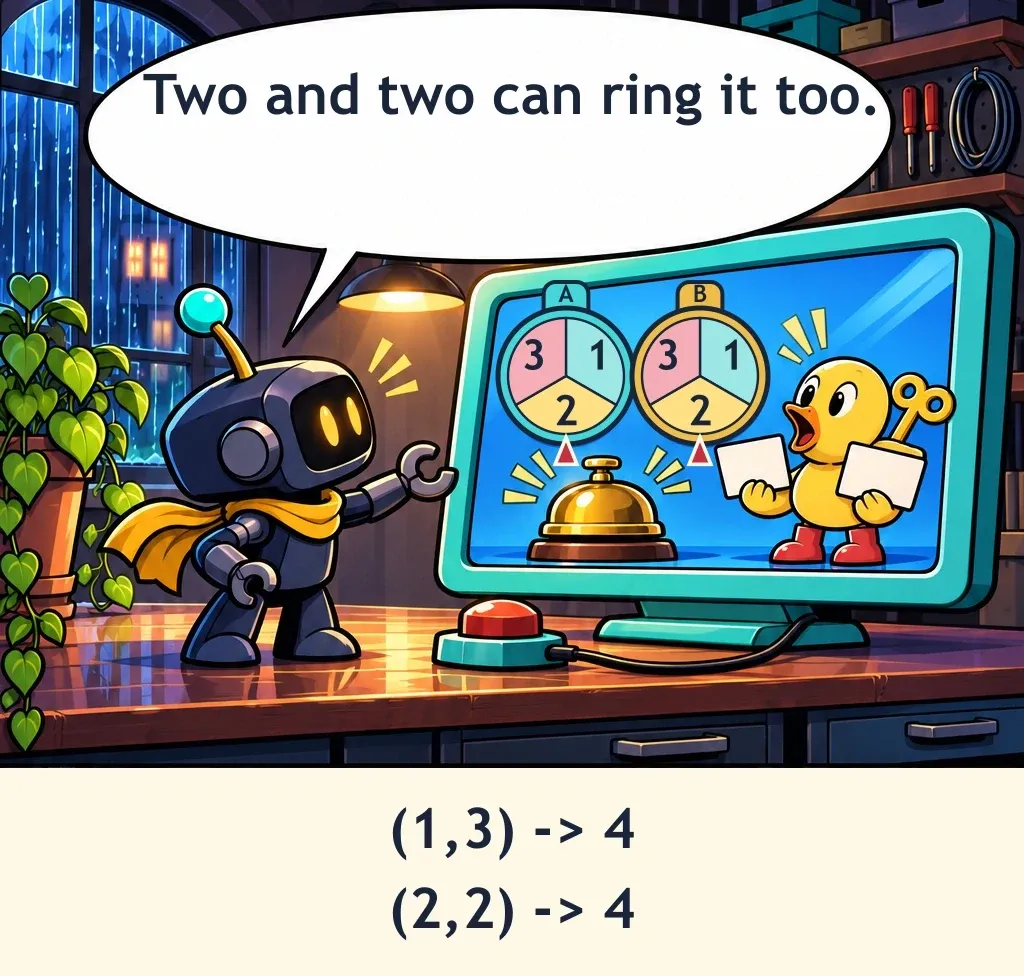
Now the same spinners give you 2 and 2. Duck is holding both the result cards, besides the old 1 and 3. 4 is the sum of both the pairs.
Diagram values: (1,3) -> 4; (2,2) -> 4
Robot: Two and two can ring it too.
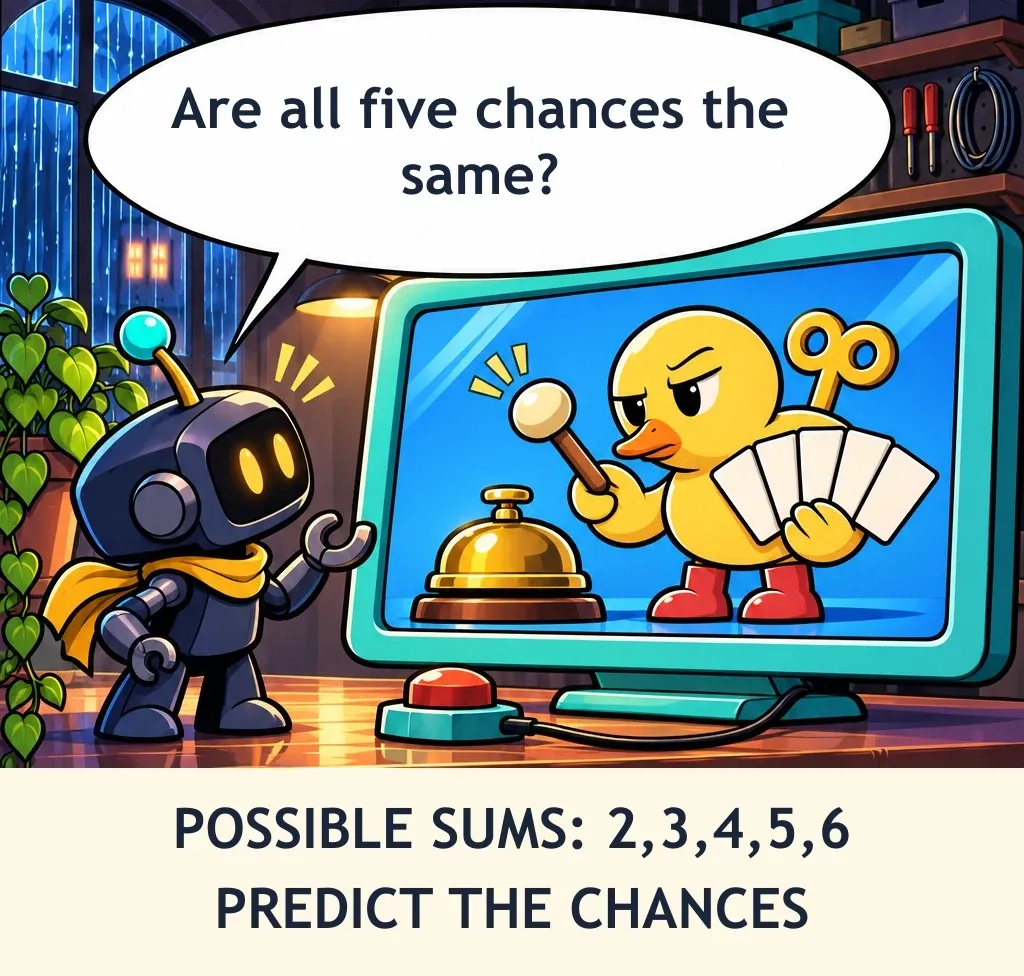
Robot points at five sum cards: 2-6. Duck stops with bell mallet raised. No probability answer shown yet.
Diagram values: POSSIBLE SUMS: 2,3,4,5,6; PREDICT THE CHANCES
Robot: Are all five chances the same?
Build every possible pair
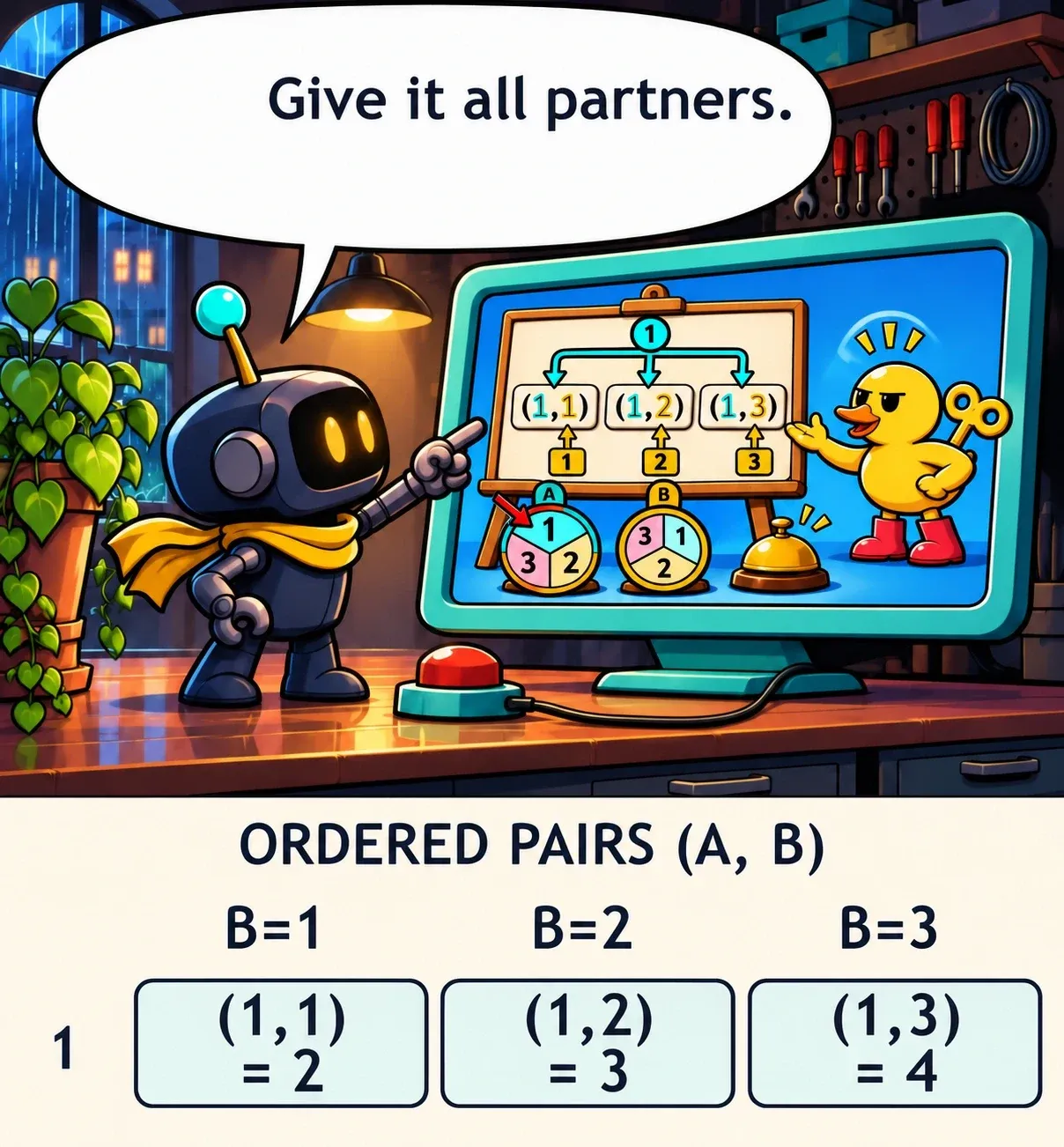
Robot points, as Duck's three pair cards are placed in a row. First spinner result one paired with second spinner result one, two or three on each card in the row. This is a list of possibilities not trial counts observed.
Diagram values: A=1; (1,1)=2; (1,2)=3; (1,3)=4
Robot: Give it all partners.
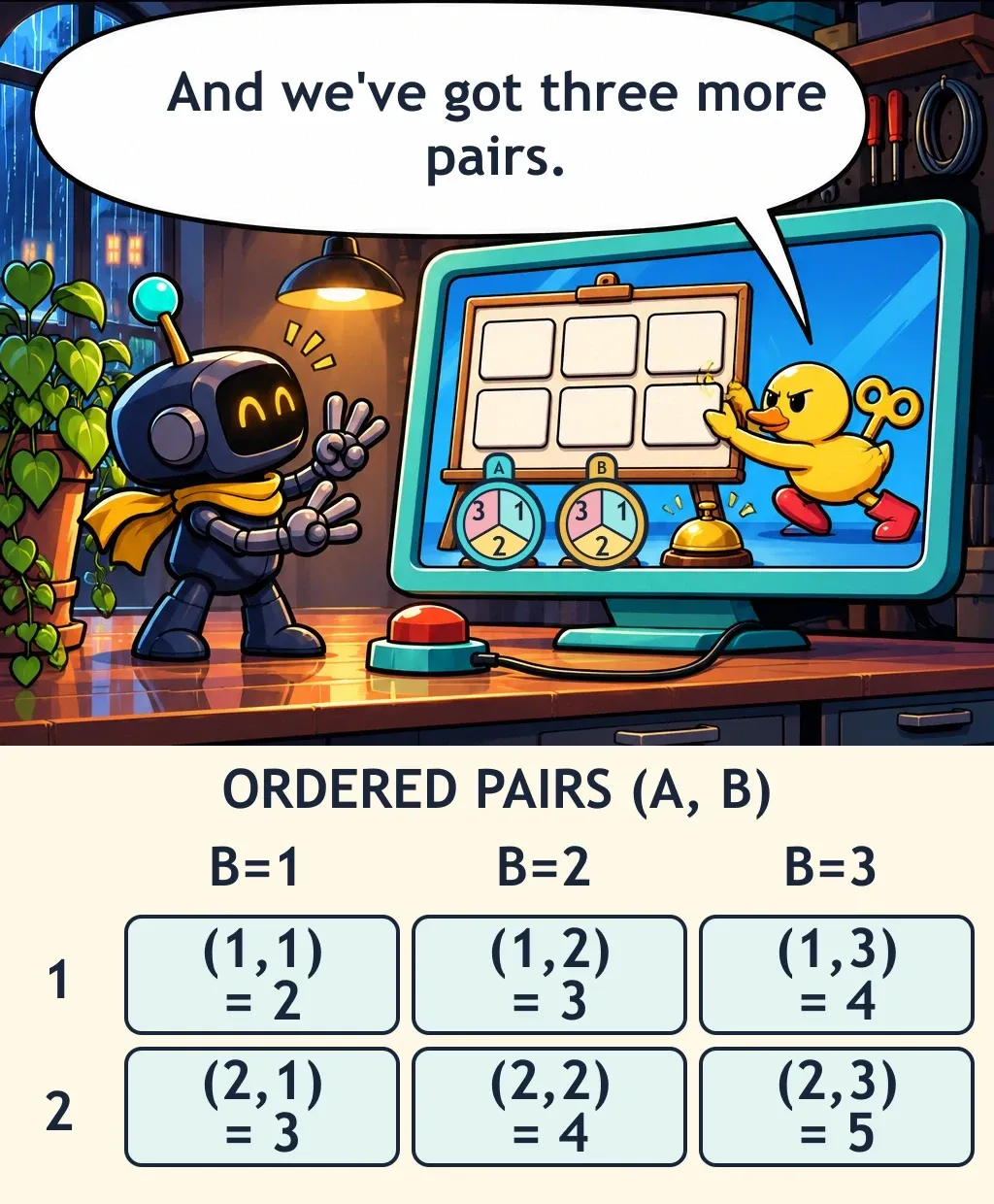
Duck adds 3 cards down again. The first spinner is 2 in each pair. The second spinner is 1 2 or 3
Diagram values: A=2; (2,1)=3; (2,2)=4; (2,3)=5
Duck: And we've got three more pairs.
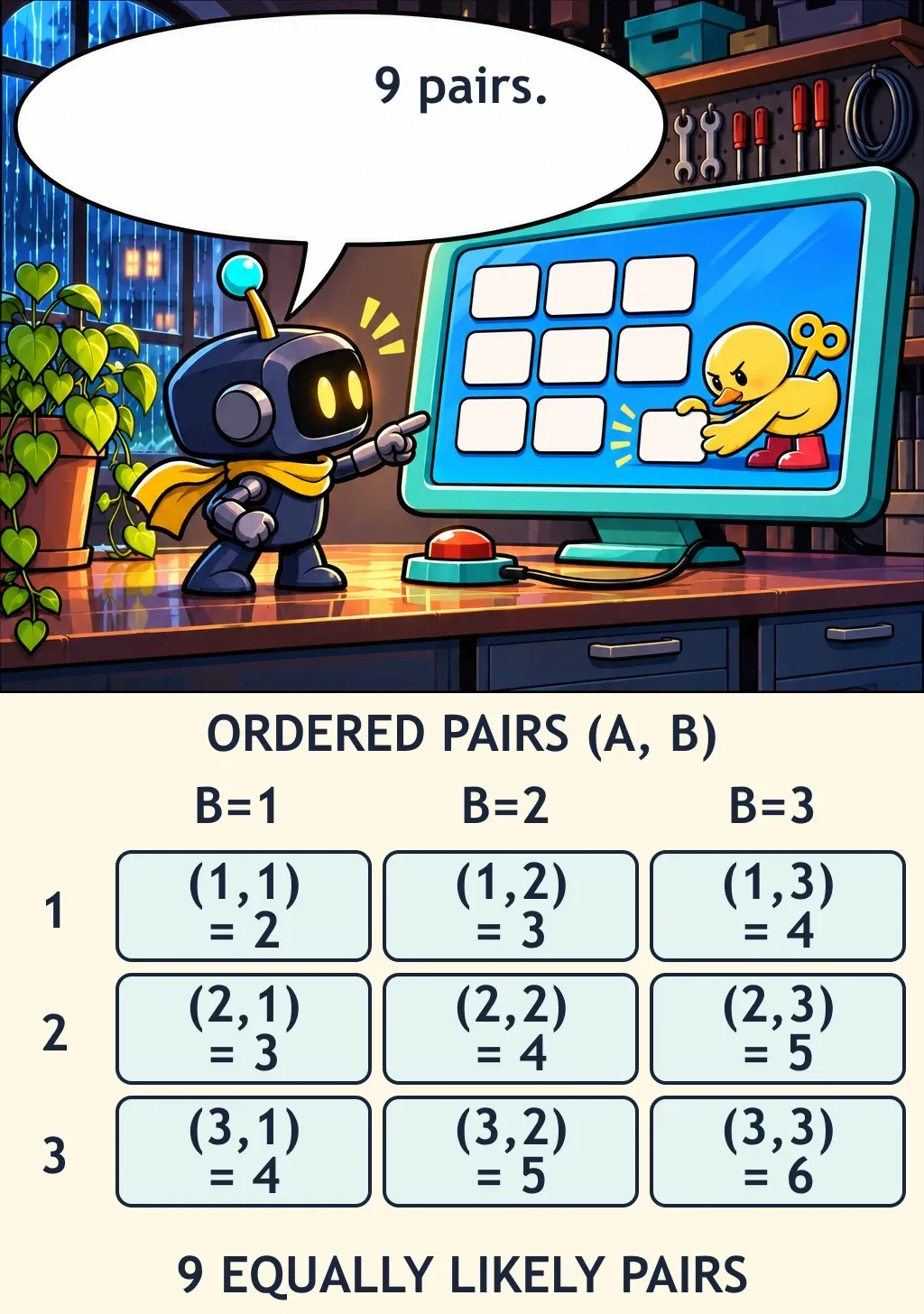
Duck places the last card to the bottom row. Now we have 9 ordered pairs, in 3 rows and 3 columns. First spinner: Aqua. Second: gold.
Diagram values: A=3; (3,1)=4; (3,2)=5; (3,3)=6; 9 EQUALLY LIKELY PAIRS
Robot: 9 pairs.
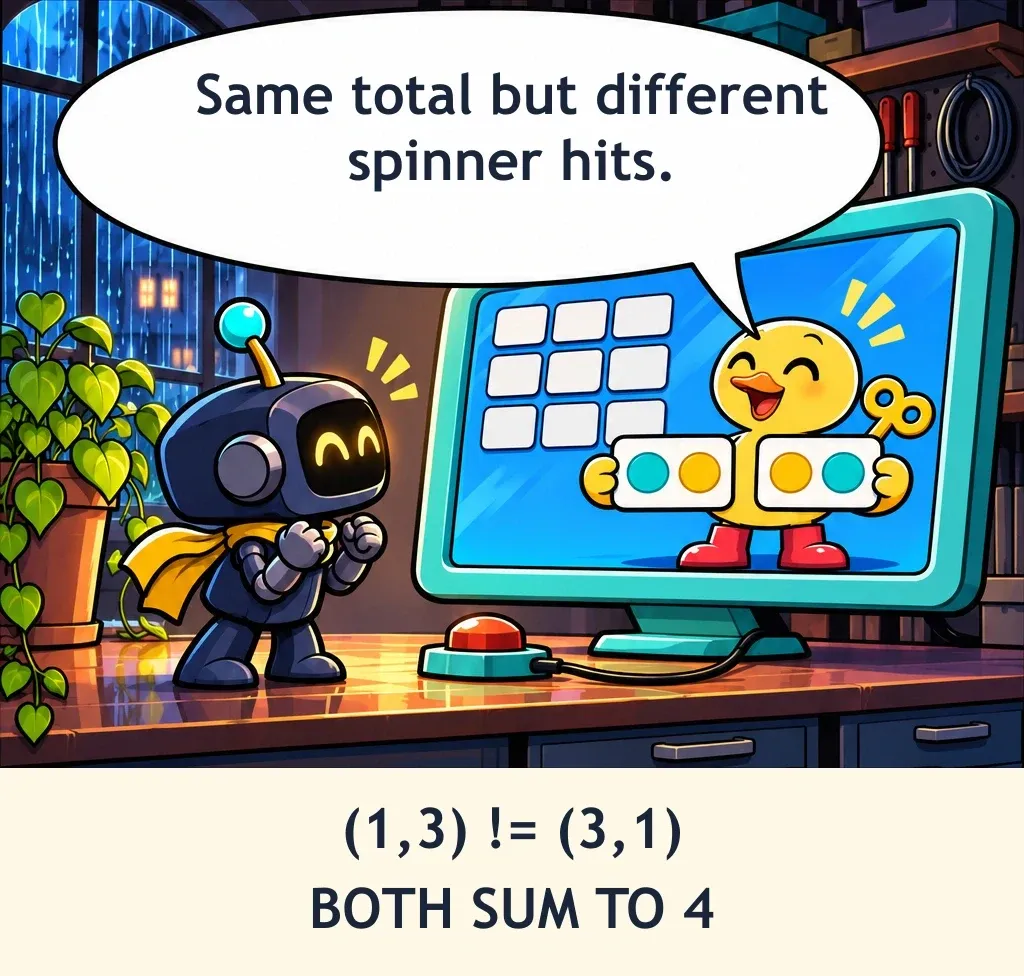
Duck compares 1-3 with 3-1. The aqua and gold places have swapped. Both sum labels are 4.
Diagram values: (1,3) != (3,1); BOTH SUM TO 4
Duck: Same total but different spinner hits.
Count the routes
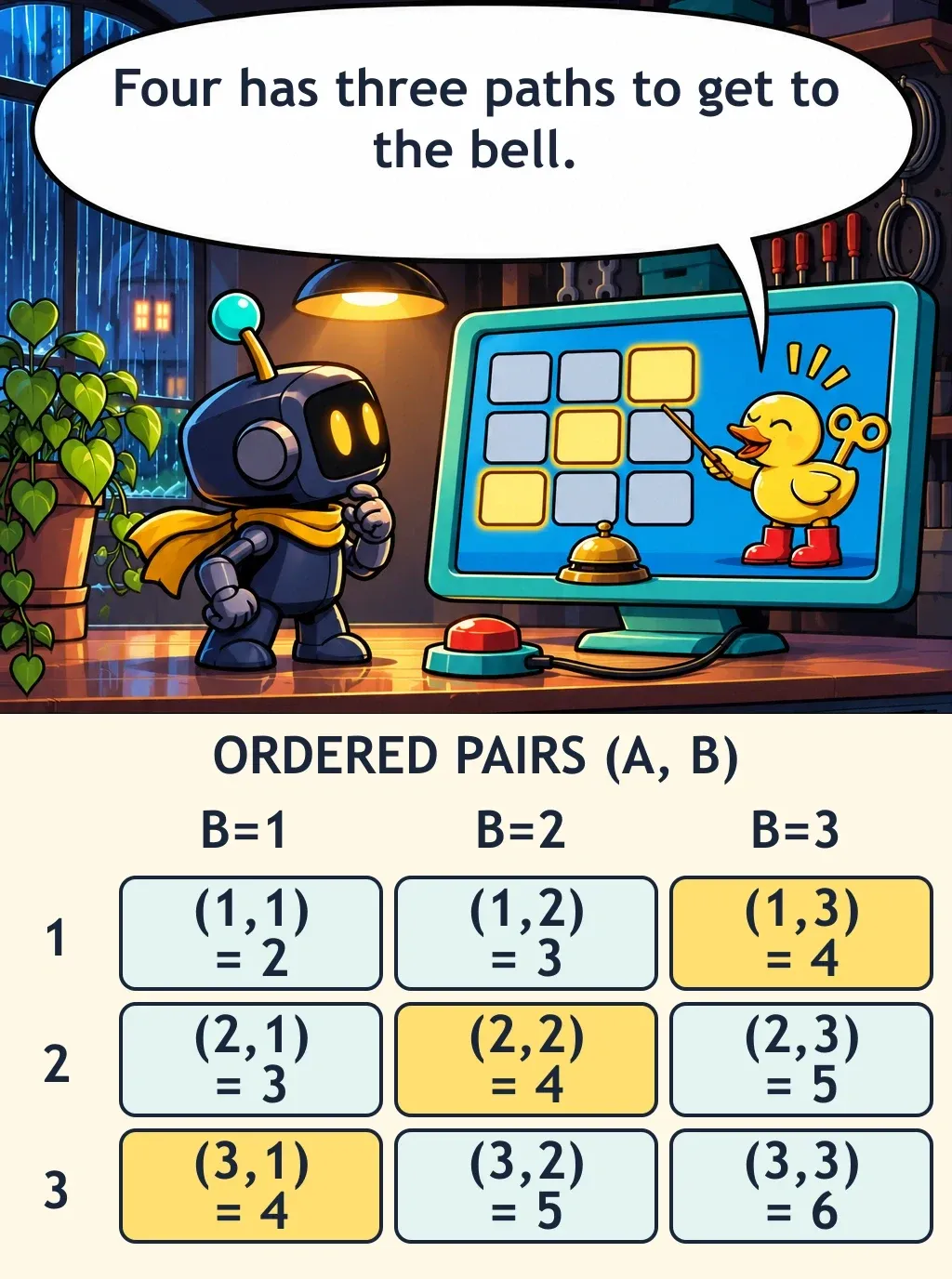
Duck points to the 3 pairs of highlighted cards out of the 9 visible. They are (1,3) (2,2) (3,1) all summing to 4. All other 6 pairs are still visible.
Diagram values: SUM 4: (1,3),(2,2),(3,1); 3 OF 9 PAIRS
Duck: Four has three paths to get to the bell.
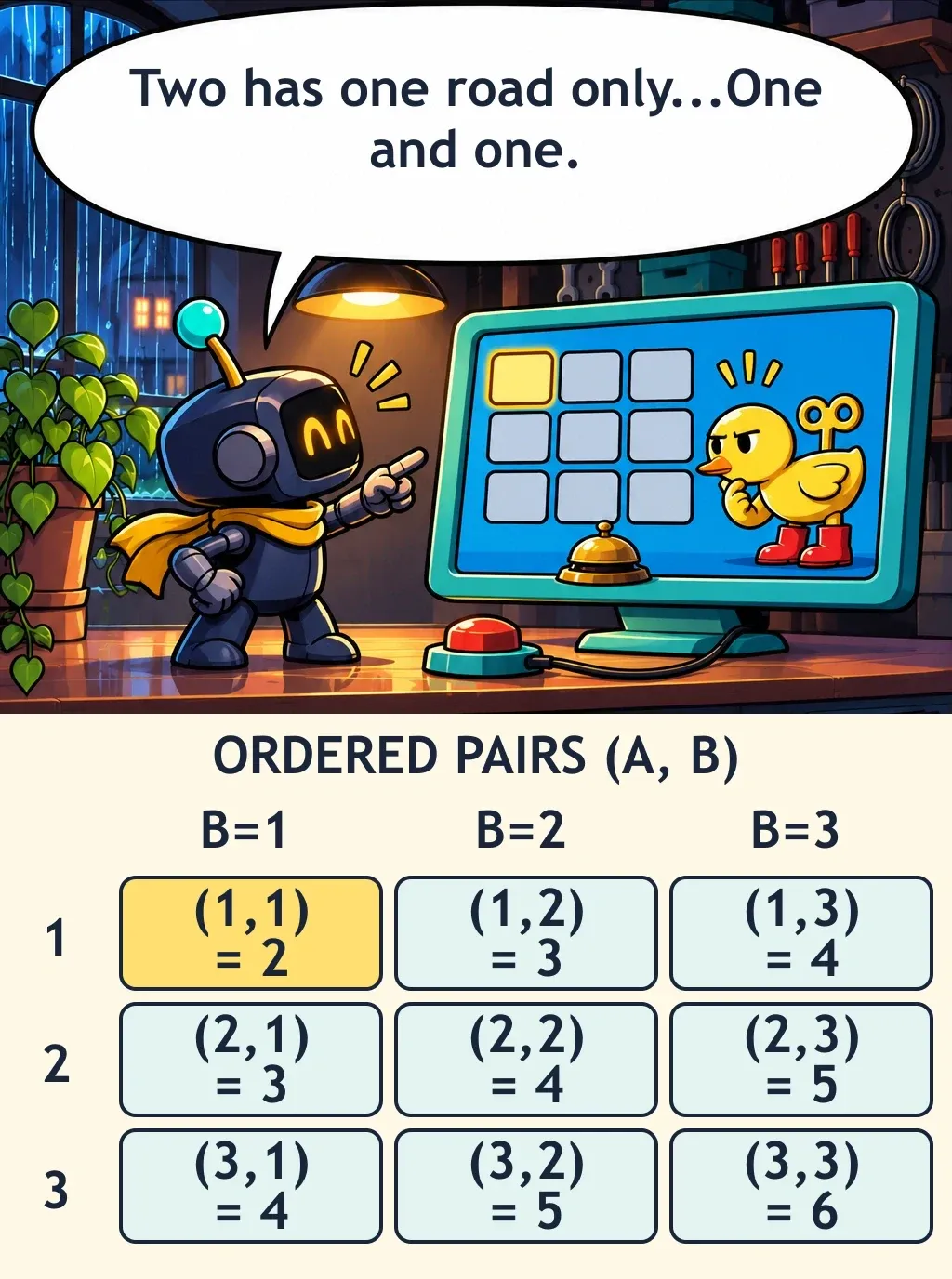
Robot points at single one one on the same board. All other pairs are visible, but not highlighted.
Diagram values: SUM 2: (1,1); 1 OF 9 PAIRS
Robot: Two has one road only...One and one.
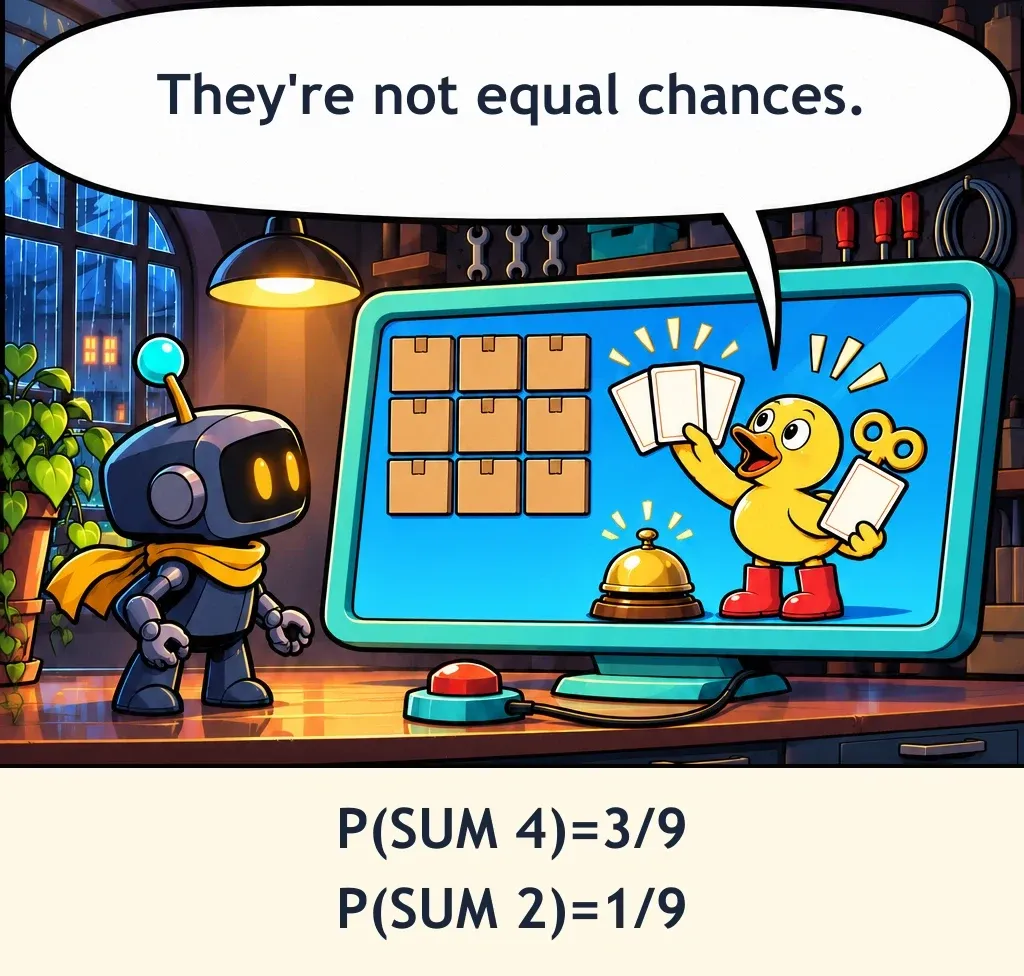
Duck has three in one wing, one in the other, comparing the odds of getting four and two. Robot looks on, outside the monitor. 9 cards on board still showing.
Diagram values: P(SUM 4)=3/9; P(SUM 2)=1/9
Duck: They're not equal chances.
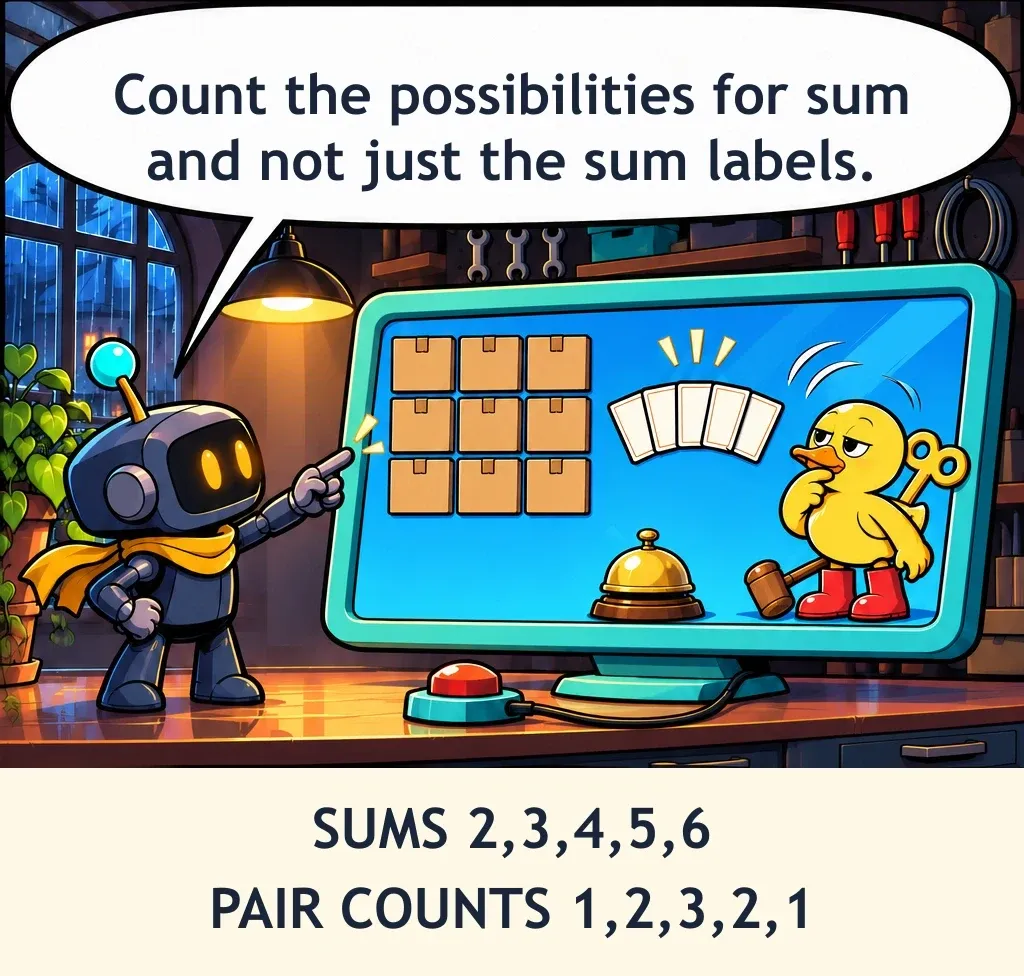
Robot gestures 9-pairs, 5 sum labels. Duck puts down the mallet, inspects the mismatched sets.
Diagram values: SUMS 2,3,4,5,6; PAIR COUNTS 1,2,3,2,1
Robot: Count the possibilities for sum and not just the sum labels.
One spinner changes
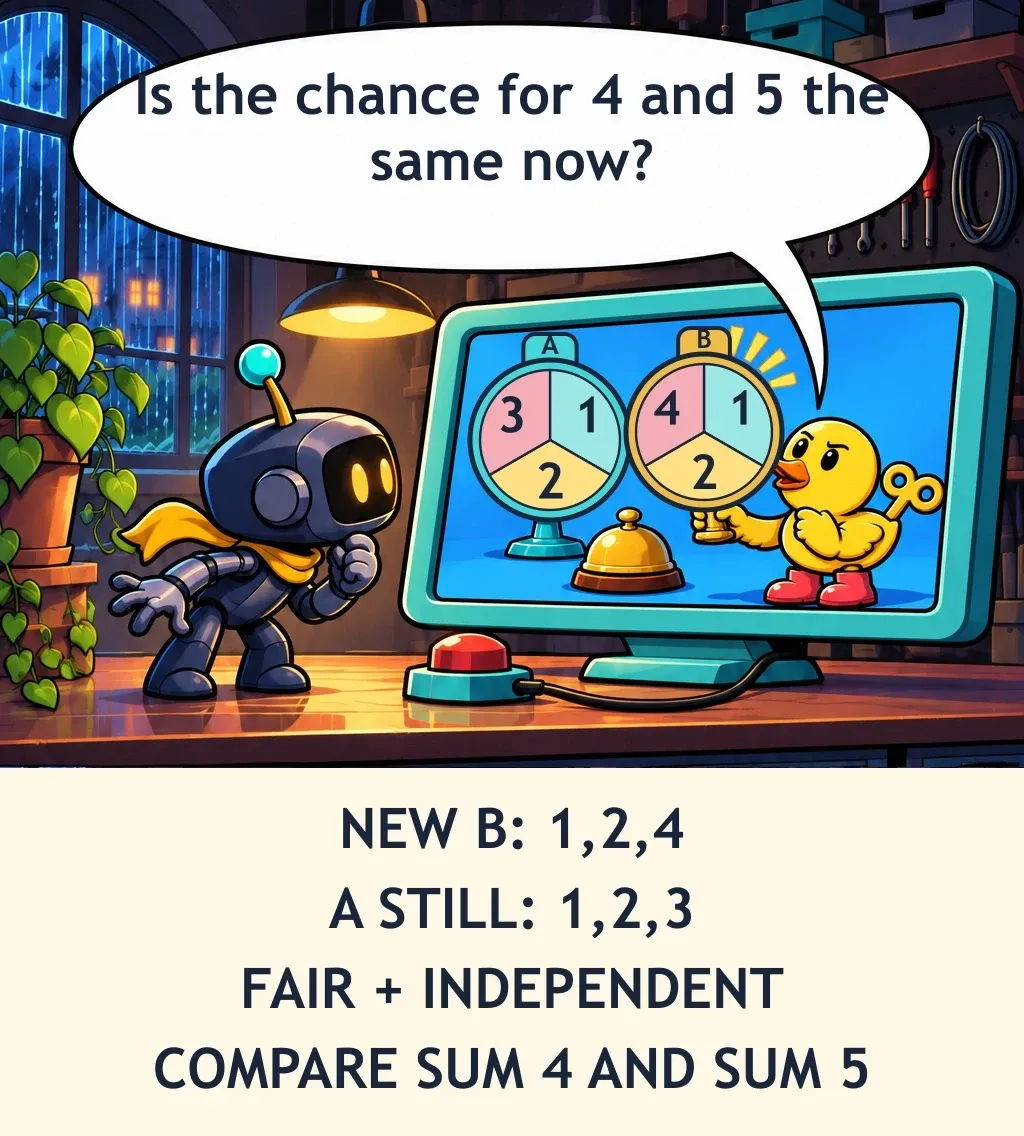
Duck only switches gold spinner out with three equal sectors labeled one, two and four. Aqua is still one, two and three. No new sums/counts have been introduced yet.
Diagram values: NEW B: 1,2,4; A STILL: 1,2,3; FAIR + INDEPENDENT; COMPARE SUM 4 AND SUM 5
Duck: Is the chance for 4 and 5 the same now?
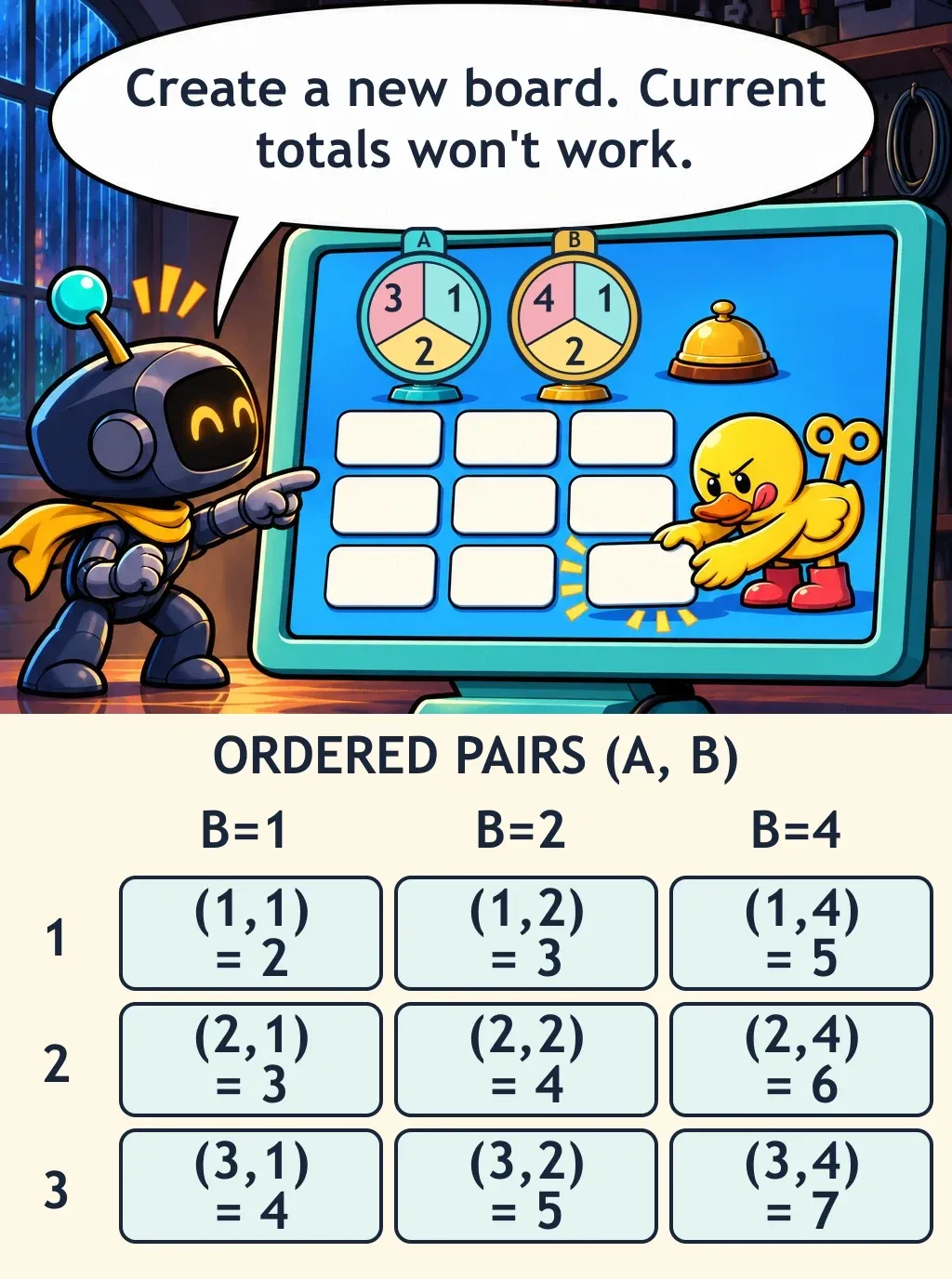
Robot makes new three by three table. Duck follows new gold column headings one, two and four. Aqua row headings are one, two and three.
Diagram values: B COLUMNS: 1,2,4; A1: 2,3,5; A2: 3,4,6; A3: 4,5,7
Robot: Create a new board. Current totals won't work.
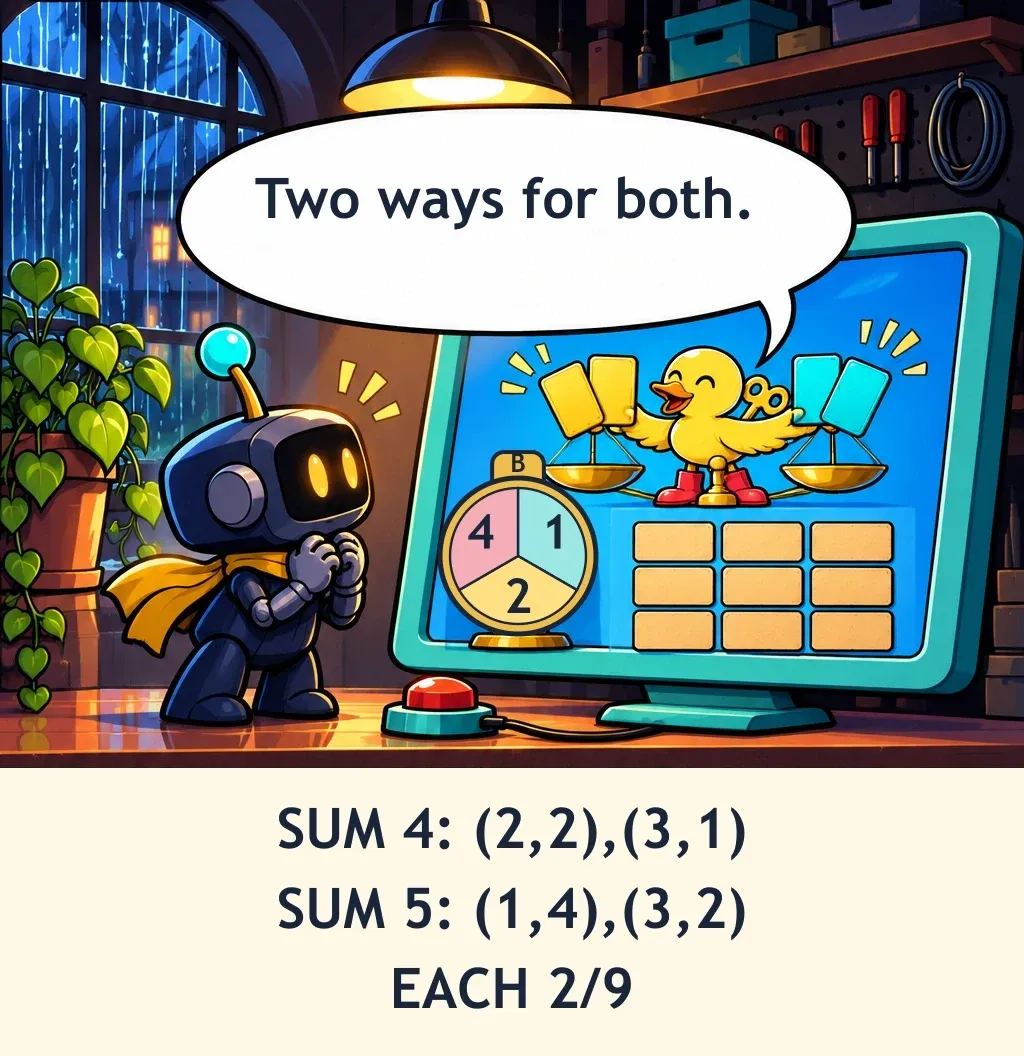
Duck points to 2 two, 3 one, sum 4. Then 1 four, 3 two, sum 5. So we have 2 pair in each color.
Diagram values: SUM 4: (2,2),(3,1); SUM 5: (1,4),(3,2); EACH 2/9
Duck: Two ways for both.
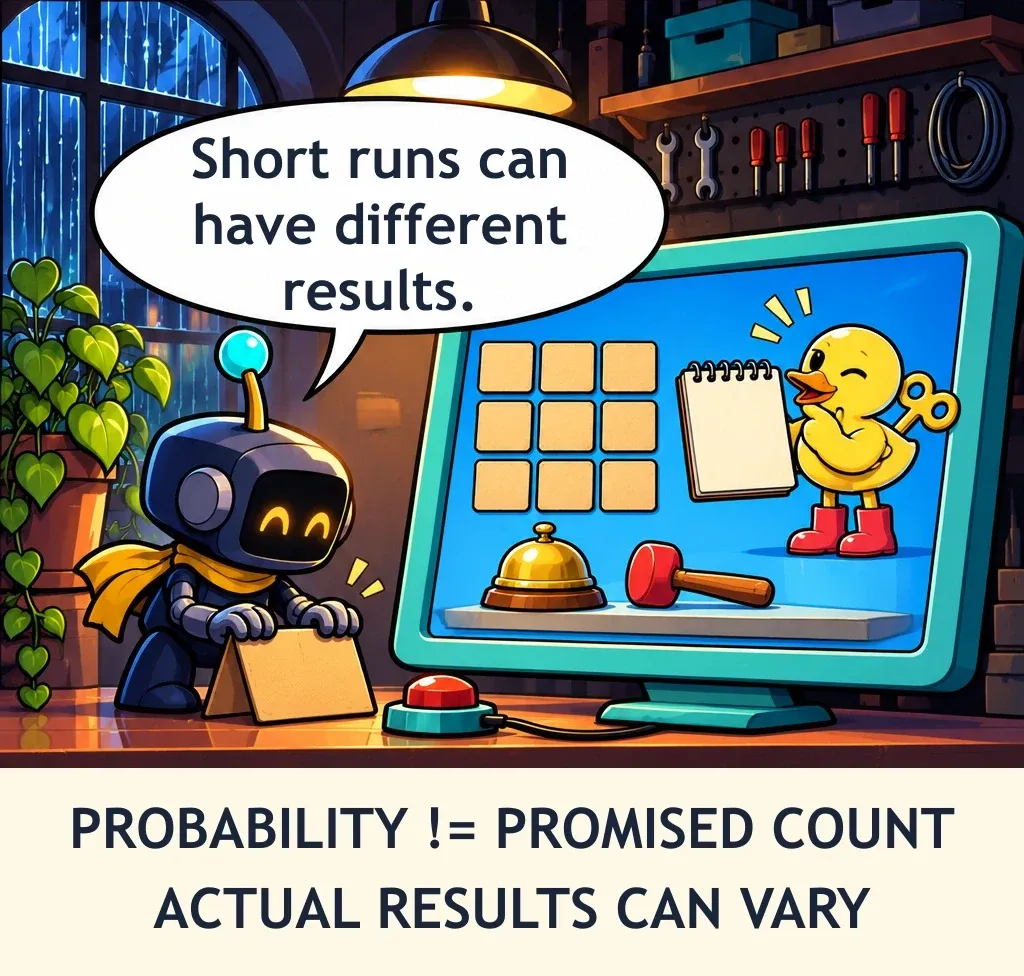
Duck has his results notebook on an empty side next to the filled possibility board. Robot tucks away a proposed fixed schedule. The board is for the possible pairs, not a guaranteed schedule of future results.
Diagram values: PROBABILITY != PROMISED COUNT; ACTUAL RESULTS CAN VARY
Robot: Short runs can have different results.
The lesson
Each fair spinner gives you: 1, 2, 3 with equal probabilities. Since they are independent, each ordered pair has a 1/9 chance. But it's important whether the 1 comes first or the 3 comes first. So (1,3) is different from (3,1) despite the same sum of 4.
There are 3 pairs where the sum is 4. Out of 9 pairs. But there's only one pair where the sum is 2. (1,1) Of the 9 pairs. So the individual spinner results are equally likely but the sums are not. This board gives you the list of possible pairs. Not a guarantee that 9 times doing this game will mean you get each of those pairs exactly once.
Duck's game is adding up two independent uniformly random numbers in the range 1..3. So 4 has 1/3 chance. A different rule you would use in a program that picks one uniformly random integer in the range 2..6 would have 4 with 1/5 chance.
Try it
Leave the first spinner numbered as 1, 2, 3. Replace the second spinner with 3 equal sectors numbered 0, 1, 2. Both spinners are fair and independent. List all ordered pairs. Are you more likely to get the sum of 3? Or 2? What is the probability for each? In 9 actual spins, are certain numbers guaranteed?
Answer
Diagram values: B=0,1,2; A=1,2,3; A=1: (1,0)=1; (1,1)=2; (1,2)=3; A=2: (2,0)=2; (2,1)=3; (2,2)=4; A=3: (3,0)=3; (3,1)=4; (3,2)=5
There are nine pairs. You can get sum three in three pairs: (1,2) (2,1) and (3,0). You can get sum two in two pairs: (1,1) and (2,0). The probability that you get sum three is three ninths. The probability that you get sum two is two ninths. That's to say, sum three is more likely than sum two. Of course, these probabilities don't mean that you will have some specific number of counts in nine real plays.