 HoldMyTwist
Episode 25
The Dial Goes Round
Duck wants more stickers when they run out of numbers on an 8 position dial. Robot asks Duck to do a full lap and see what happens to the pointer.
Episode transcript
The dial runs out of labels
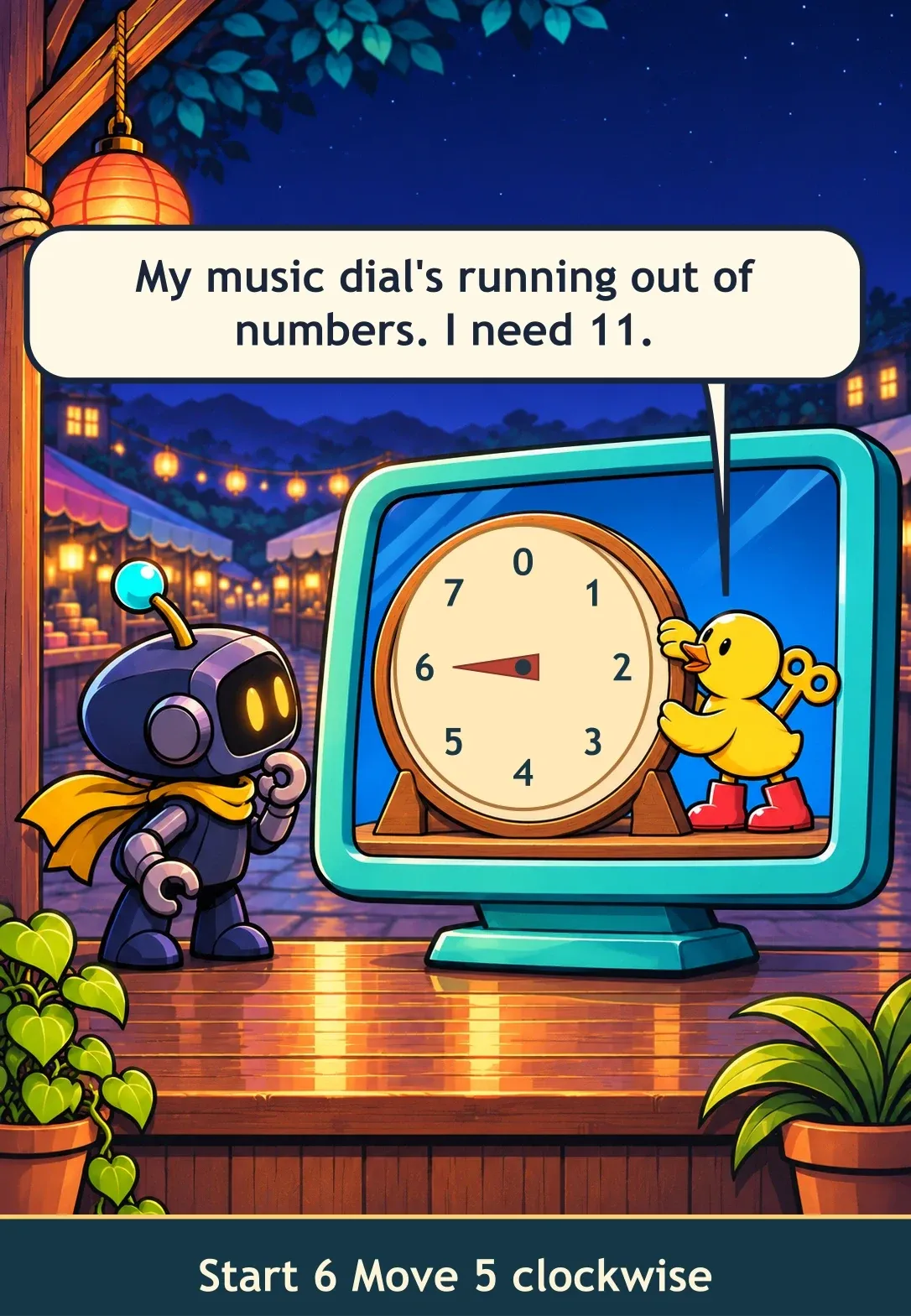
Duck is hunched over and peering at an 8 position dial in the turquoise monitor. The pointer is at 6.
Diagram values: Positions 0 through 7; Start 6; Move 5 clockwise
Duck: My music dial's running out of numbers. I need 11.
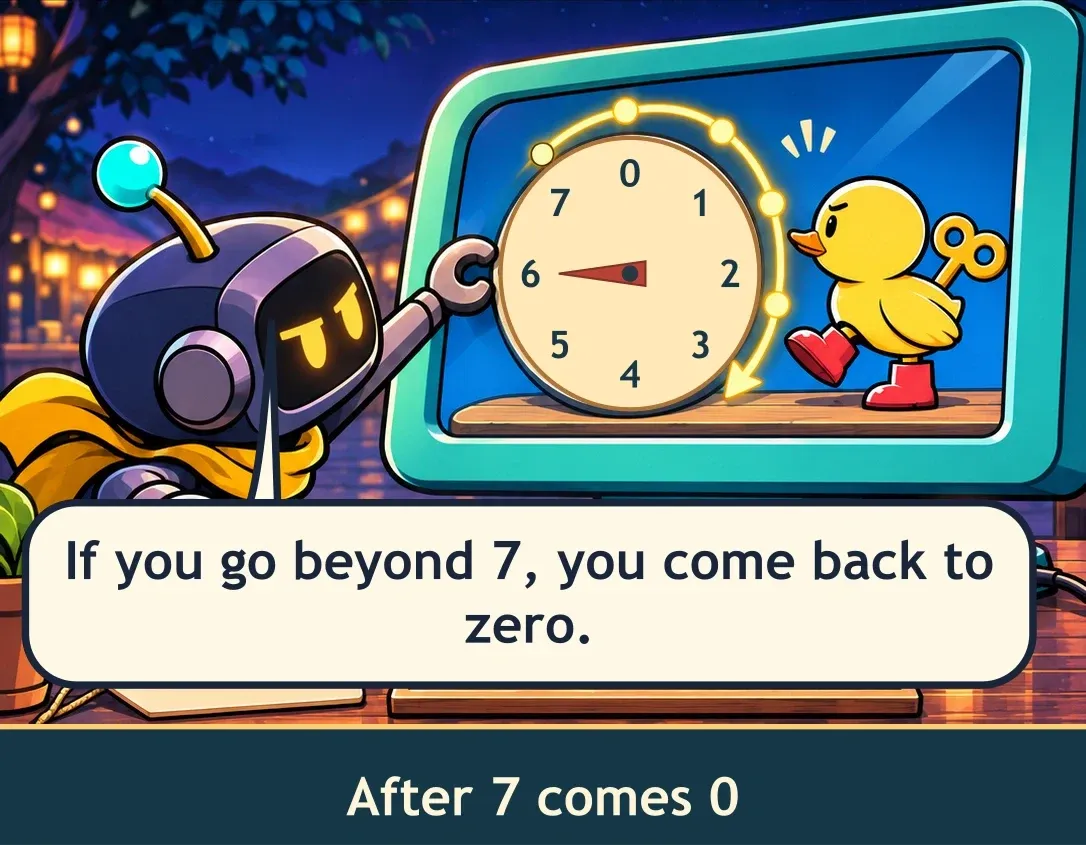
Robot points at the top where the 7 goes back to 0. Duck watches the clockwise arrow.
Diagram values: 7 → 0
Robot: If you go beyond 7, you come back to zero.
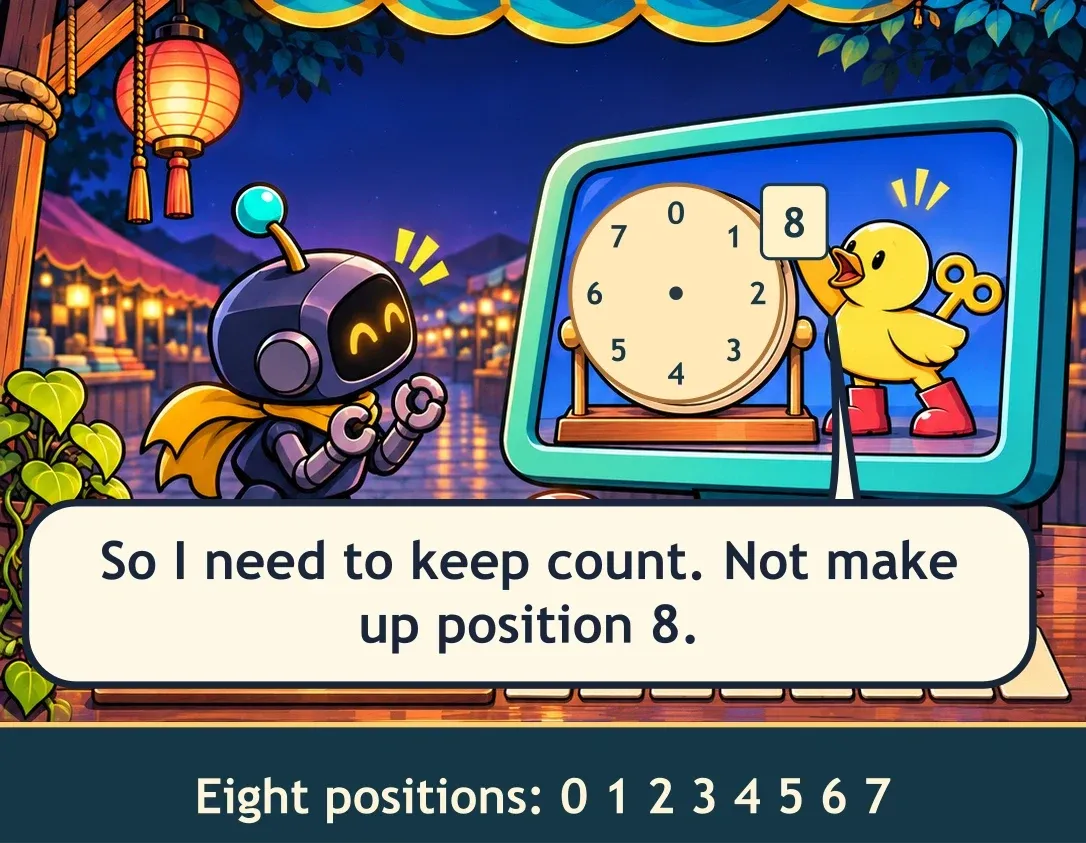
Duck rips a rogue sticker numbered 8 off. The actual dial only has 0-7 labeled.
Diagram values: 0, 1, 2, 3, 4, 5, 6, 7
Duck: So I need to keep count. Not make up position 8.
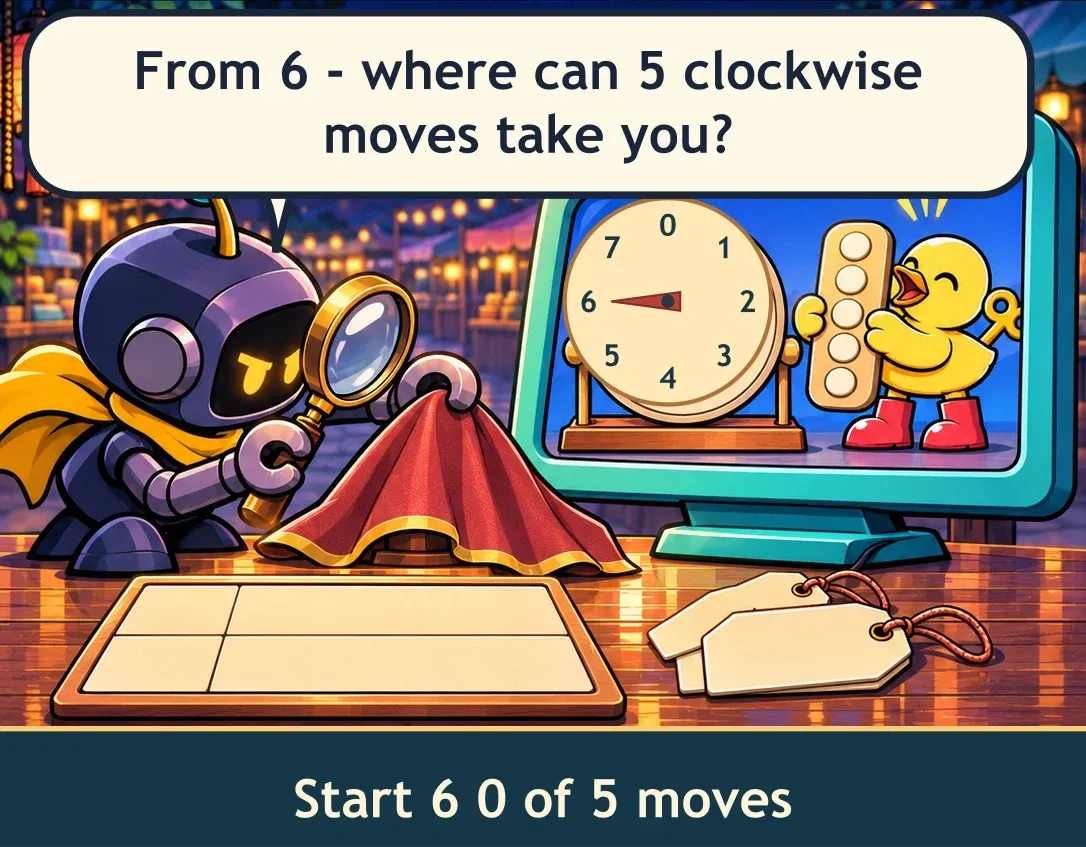
Initially the move counter is 0, starting from position 6.
Diagram values: Start 6; 5 moves remaining
Robot: From 6 - where can 5 clockwise moves take you?
Walk around zero
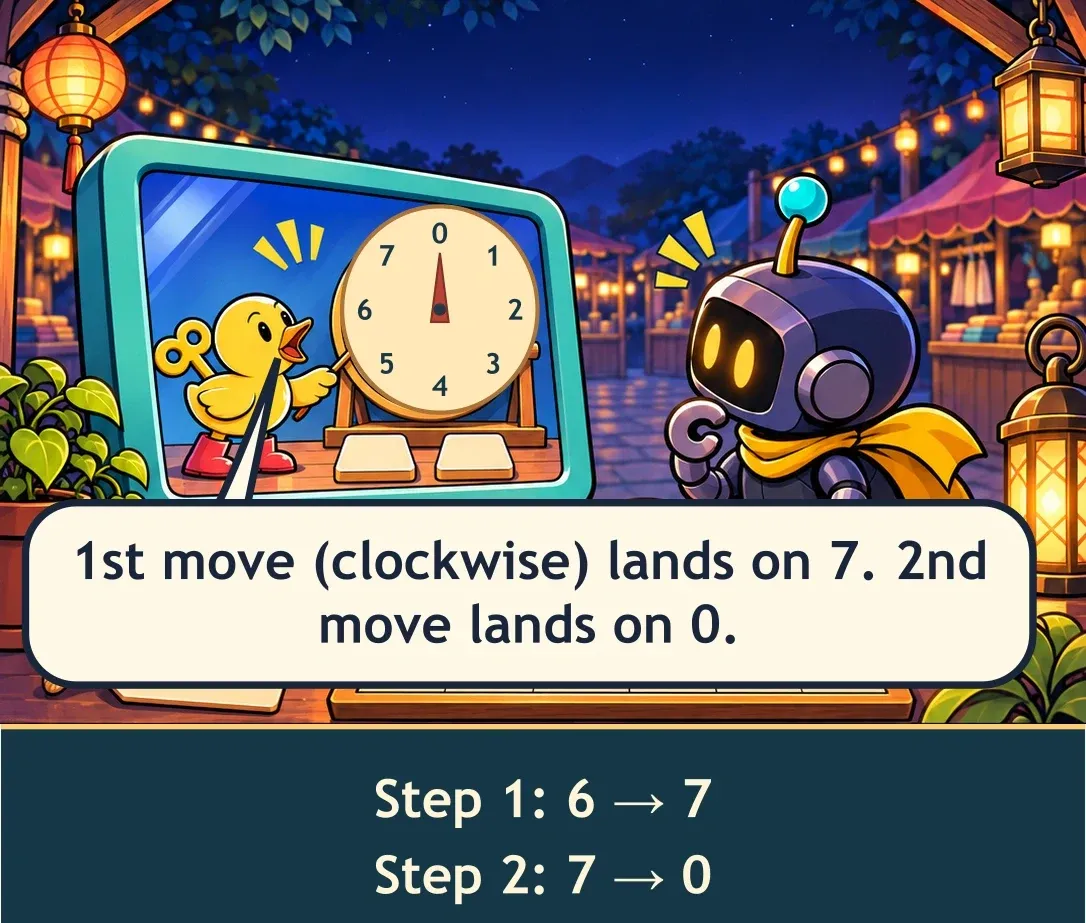
1st move (clockwise) lands on 7. 2nd move lands on 0.
Diagram values: Step 1: 7; Step 2: 0
Duck: 1st move (clockwise) lands on 7. 2nd move lands on 0.
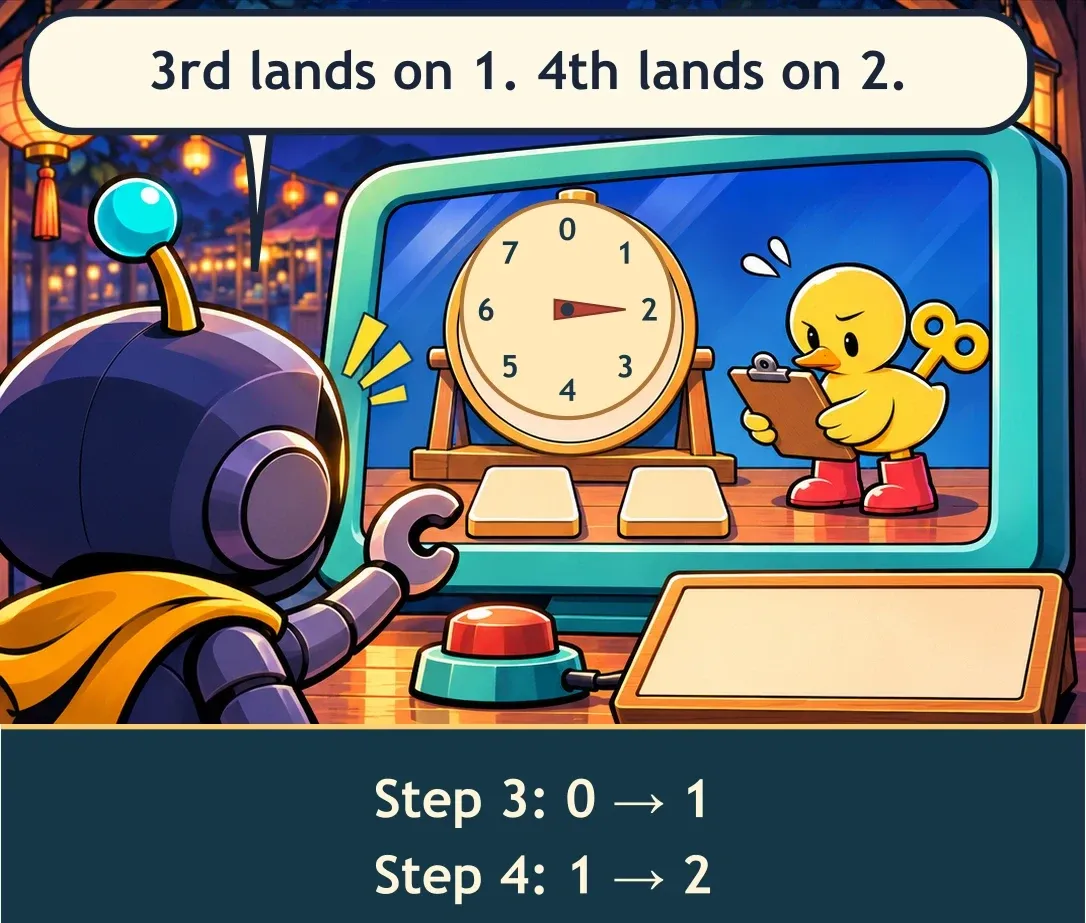
Pointer goes from zero to one and then two.
Diagram values: Step 3: 1; Step 4: 2
Robot: 3rd lands on 1. 4th lands on 2.
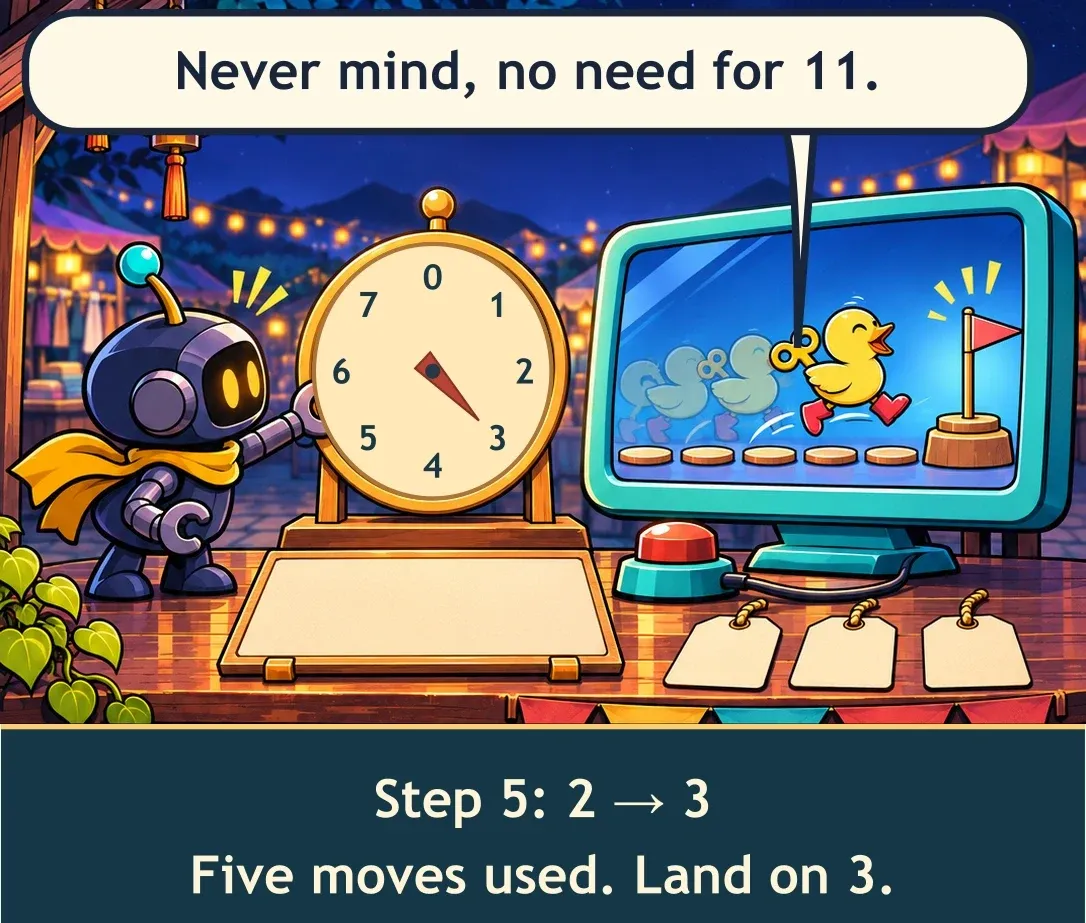
Duck gets to little finish flag at move 5. Pointer is at 3.
Diagram values: Step 5: 3
Duck: Never mind, no need for 11.
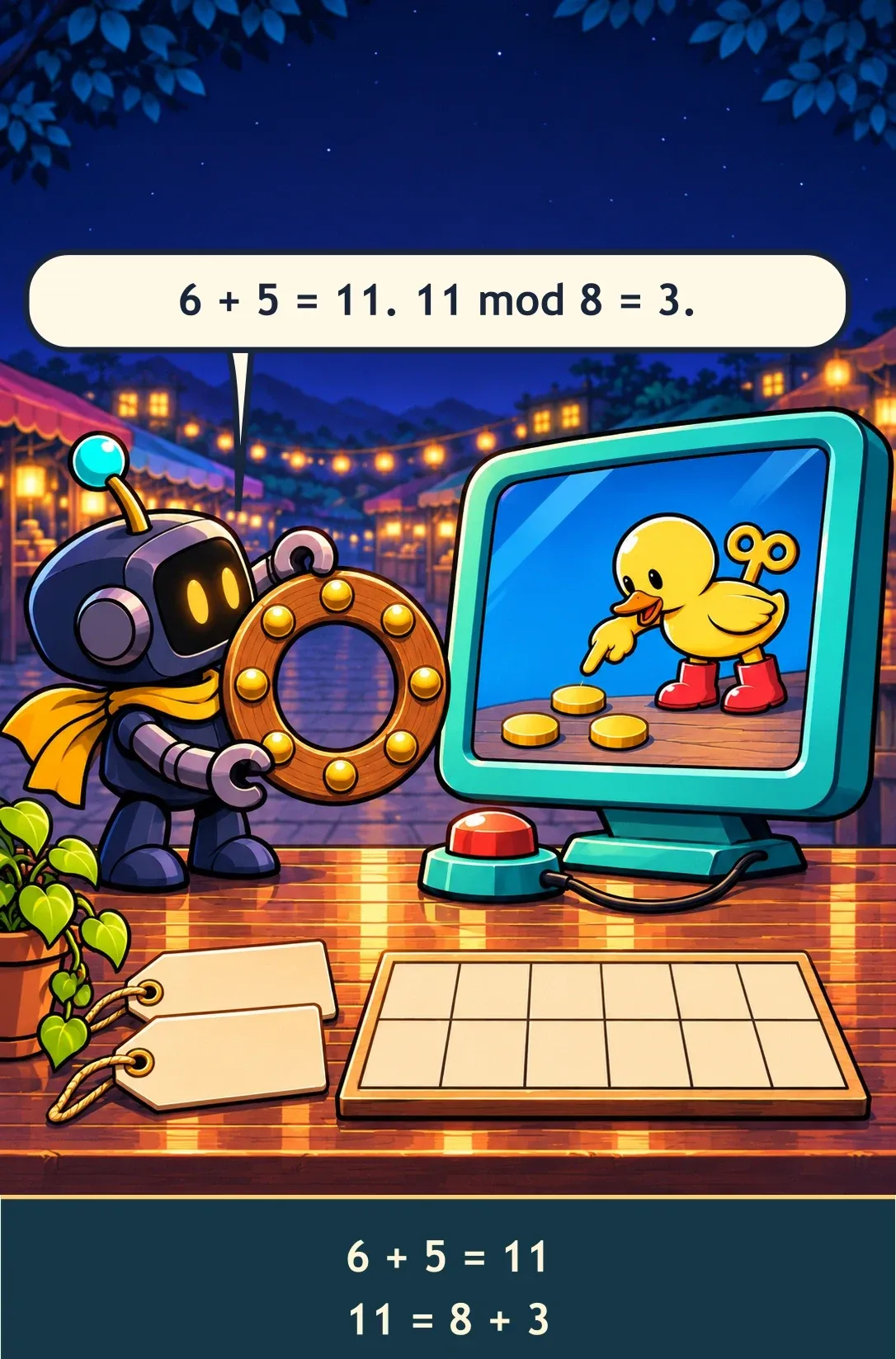
Duck is pointing to 3 extra tokens that are next to it.
Diagram values: (6 + 5) mod 8 = 3; 11 = 8 + 3
Robot: 6 + 5 = 11. 11 mod 8 = 3.
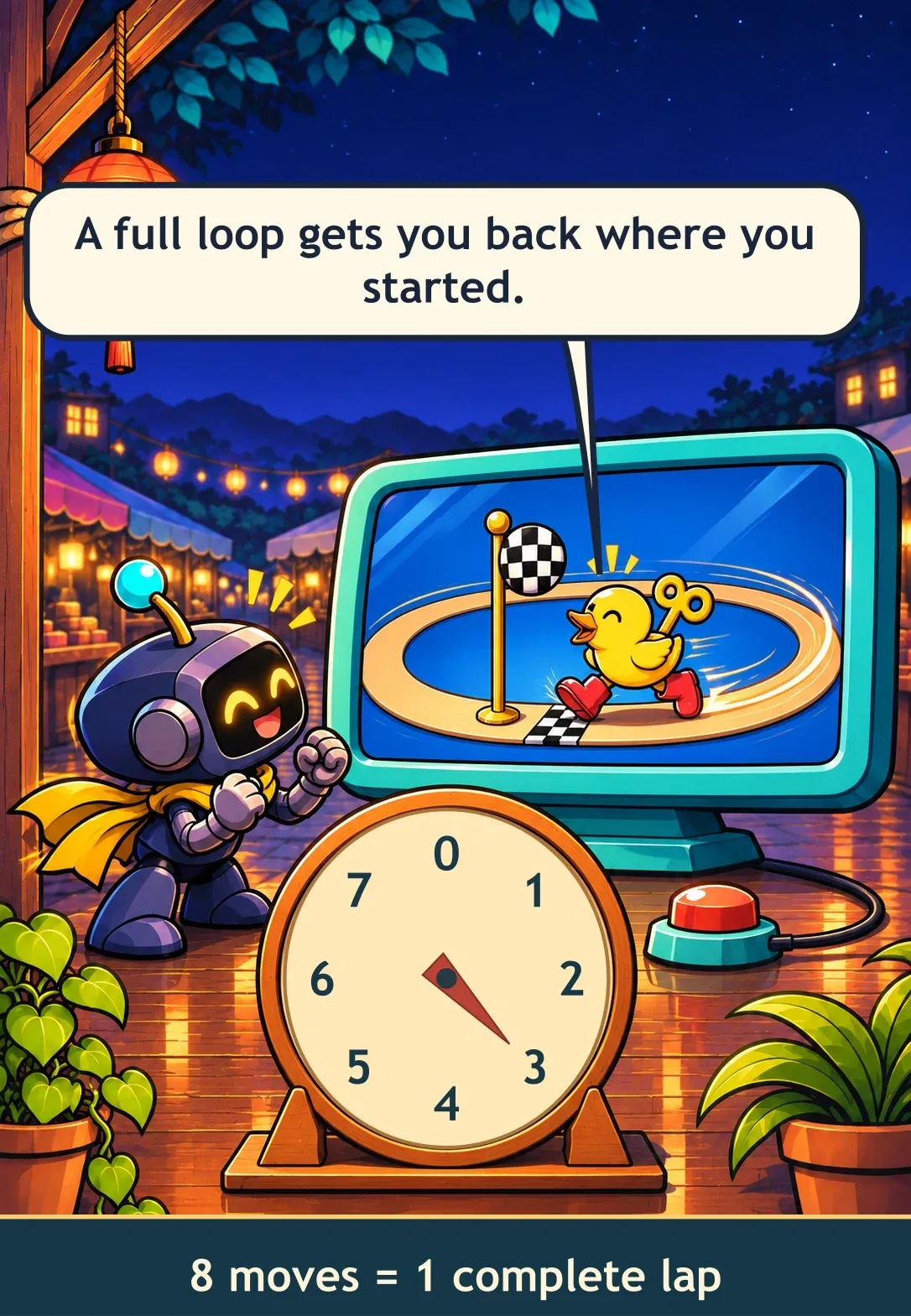
Duck completes one entire lap around. Duck is back at the same place. Robot looks at the dial.
Diagram values: 8 moves = 1 full lap
Duck: A full loop gets you back where you started.
Use the remainder
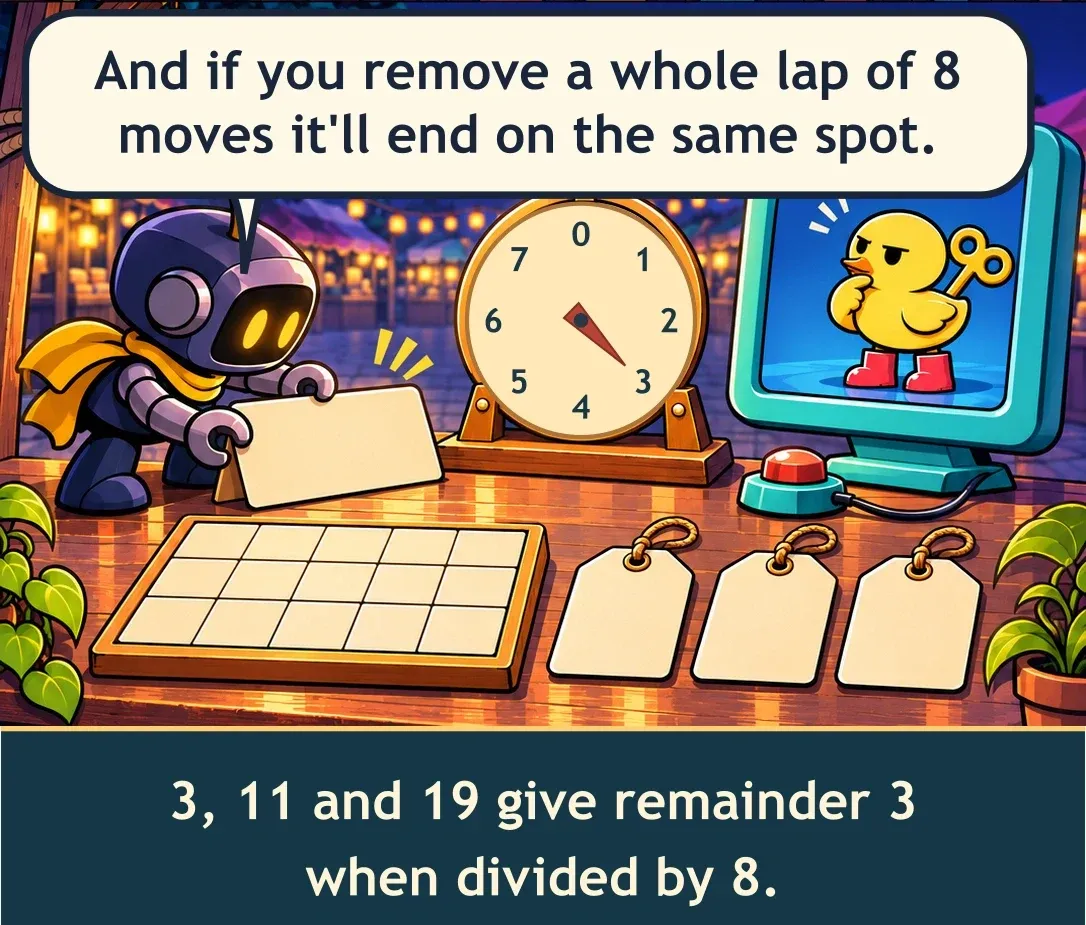
And if you remove a whole lap of 8 moves it'll end on the same spot.
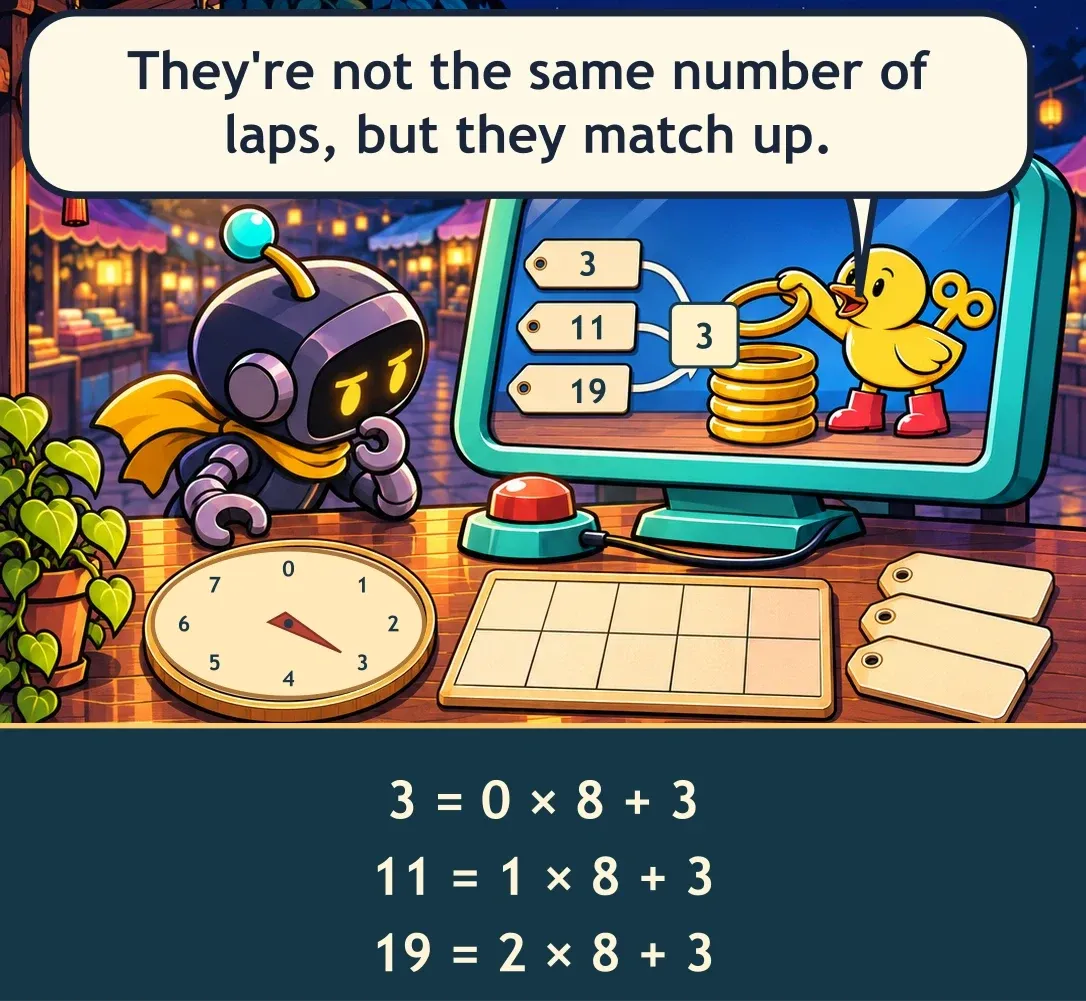
Diagram values: 3 mod 8 = 3; 11 mod 8 = 3; 19 mod 8 = 3
Robot: And if you remove a whole lap of 8 moves it'll end on the same spot.
Three tags - 3 - 11 - 19. All arrows converge on three. Duck shows lap ring.
Diagram values: 3, 11 and 19 give remainder 3
Duck: They're not the same number of laps, but they match up.
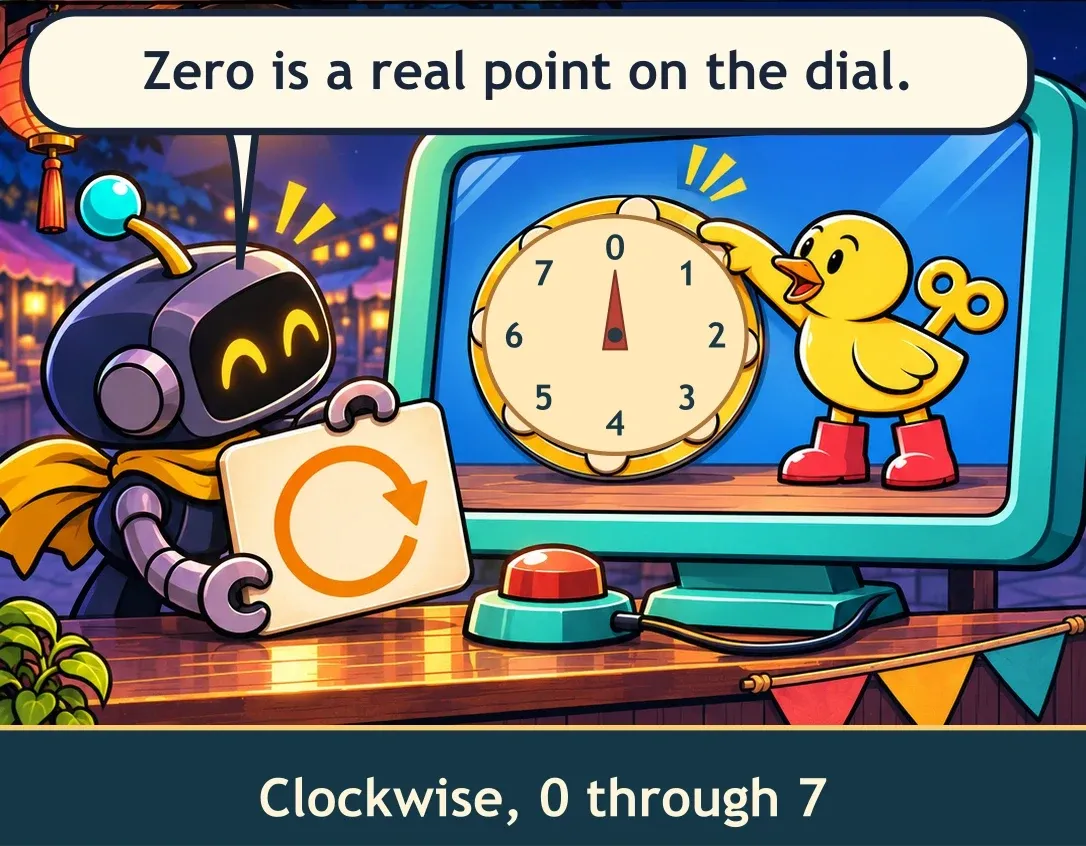
Duck watches the clockwise arrow.
Diagram values: Clockwise; Positions 0 through 7
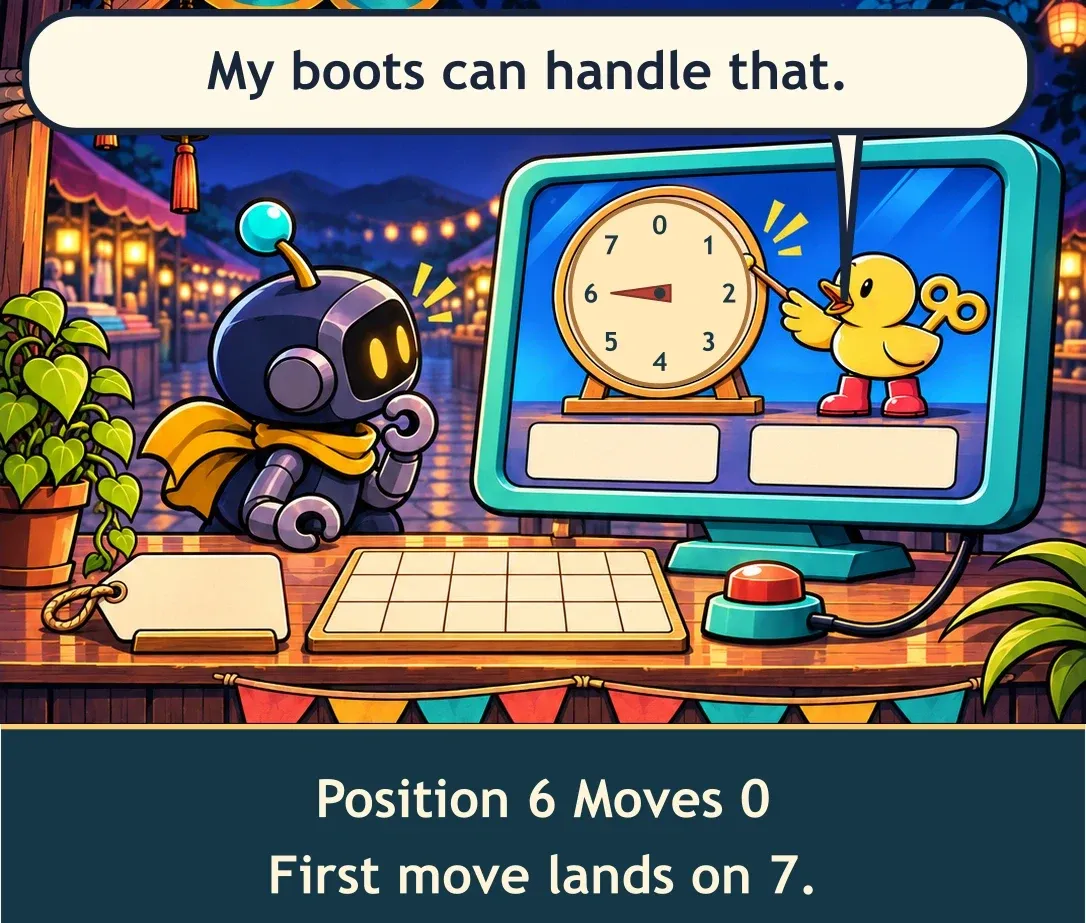
Robot: Zero is a real point on the dial.
No move has been registered yet. First move will fall on seven.
Diagram values: Starting position 6; Moves taken: 0
Duck: My boots can handle that.
More than one lap
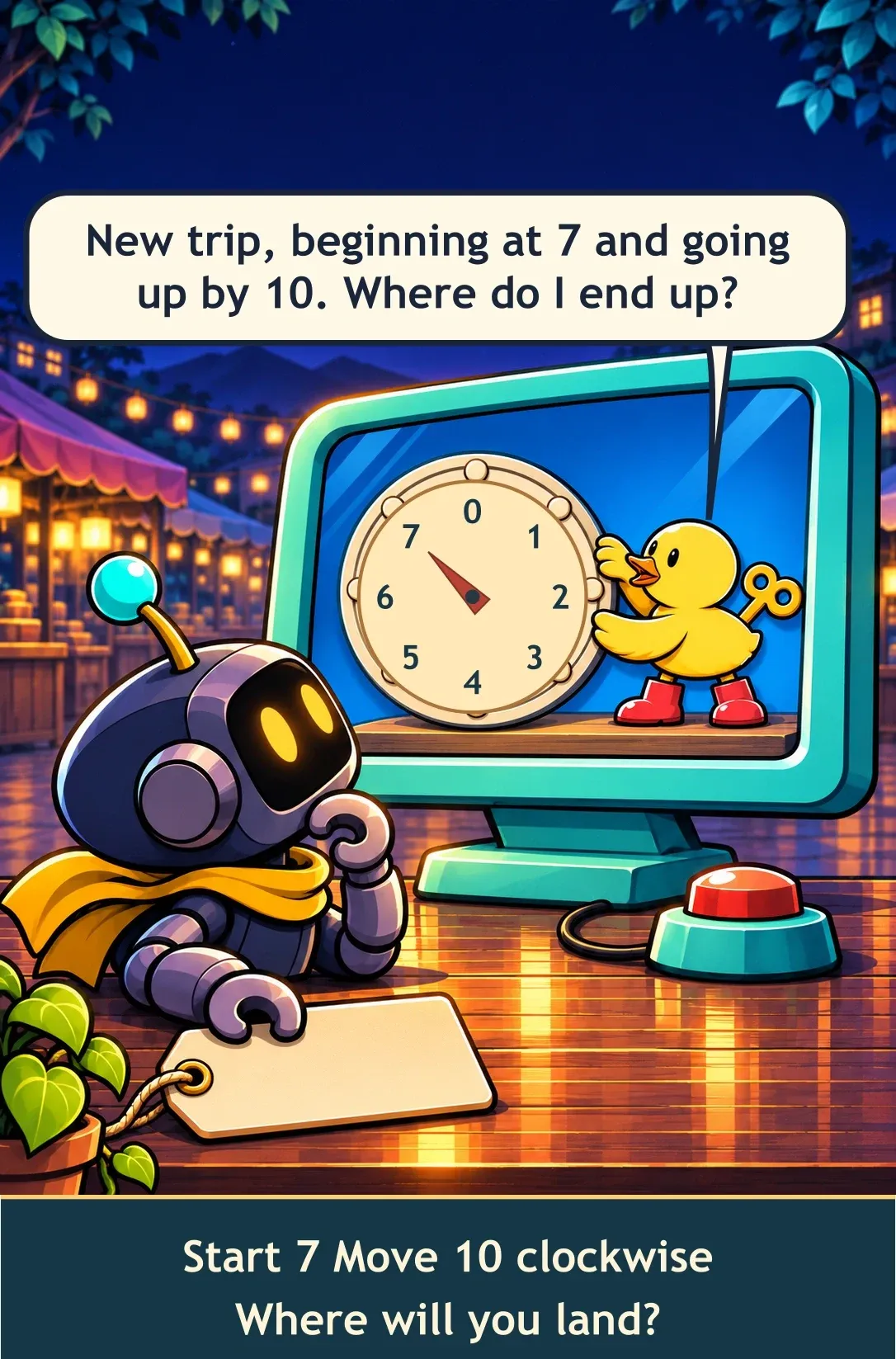
Duck begins at 7 a new trip. Robot hides the result. You have 10 clockwise moves.
Diagram values: Start 7; Move 10 clockwise
Duck: New trip, beginning at 7 and going up by 10. Where do I end up?
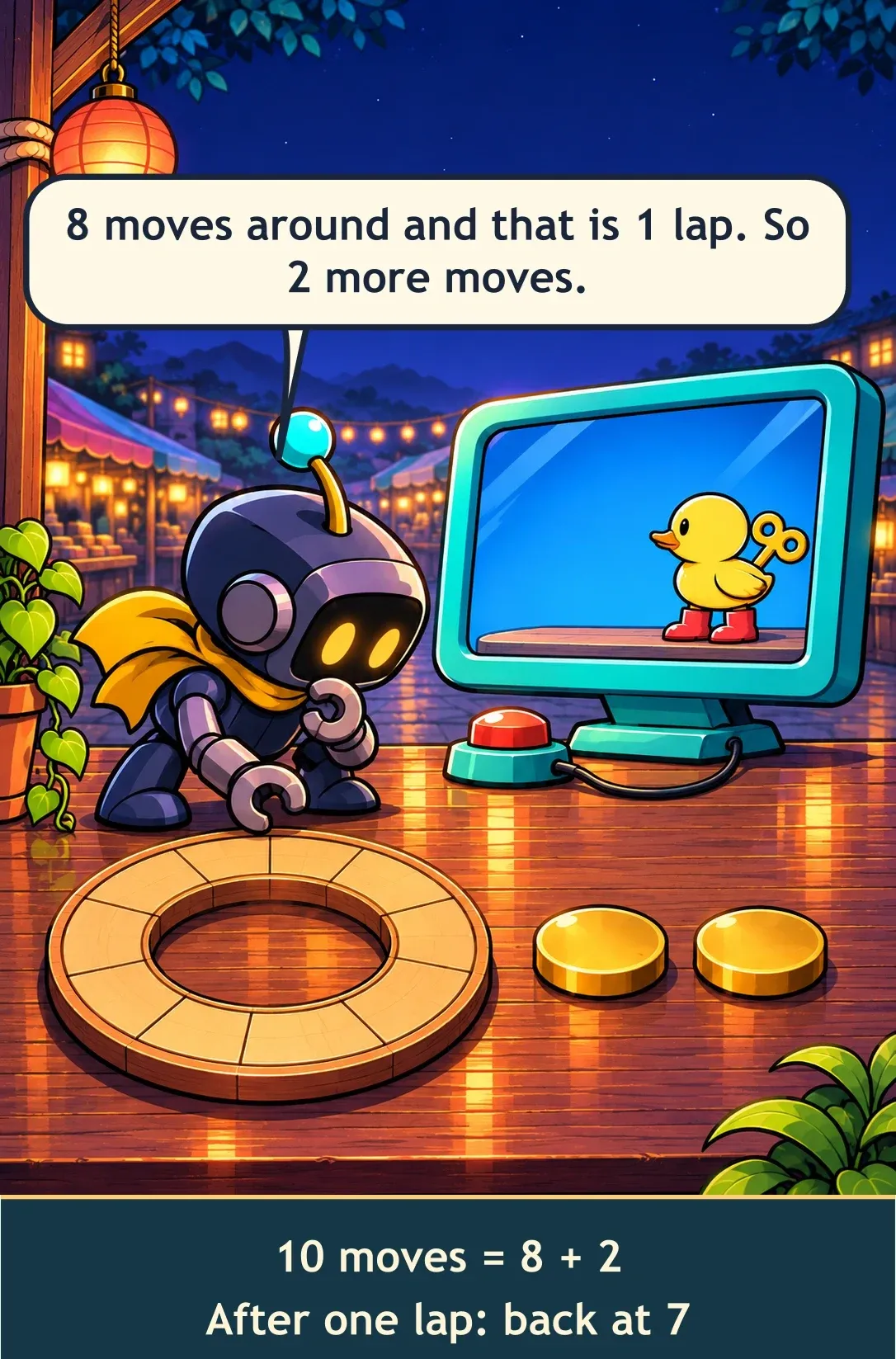
The desk has two loose tokens on it. Duck returns to starting position.
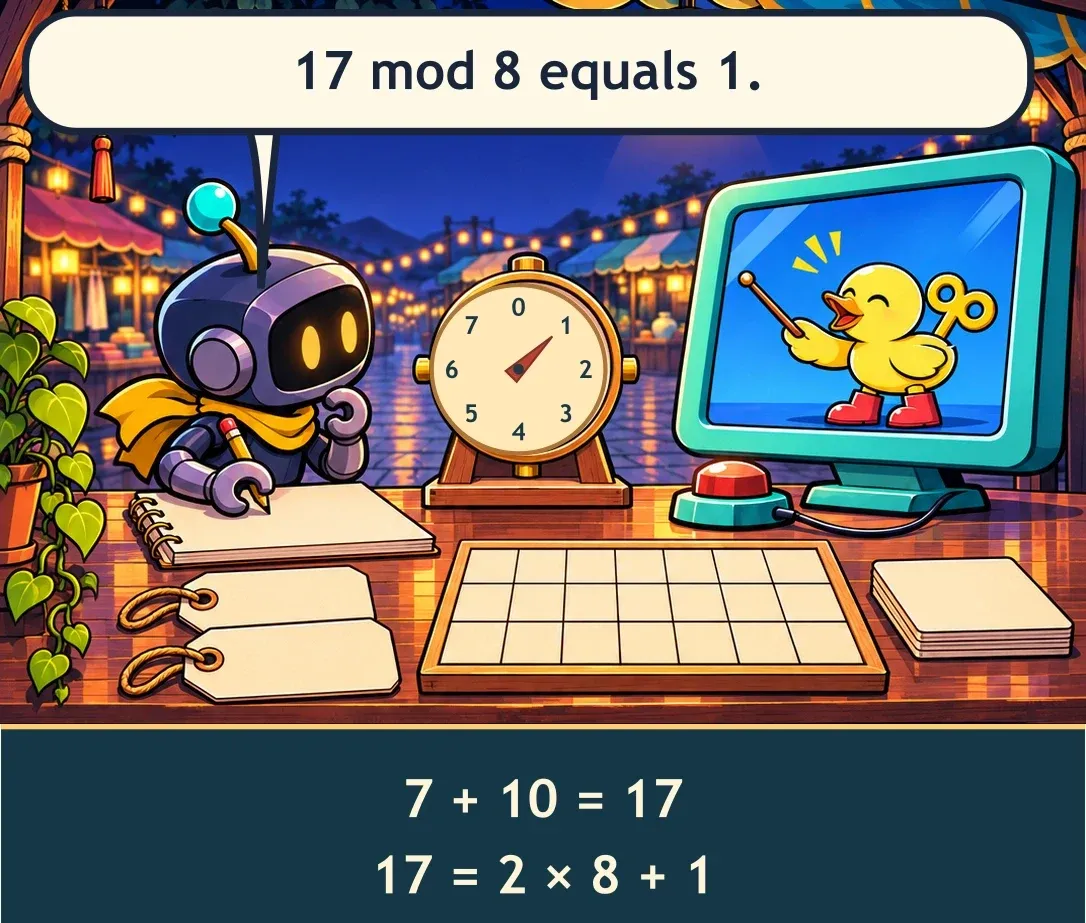
Diagram values: 10 = 8 + 2
Robot: 8 moves around and that is 1 lap. So 2 more moves.
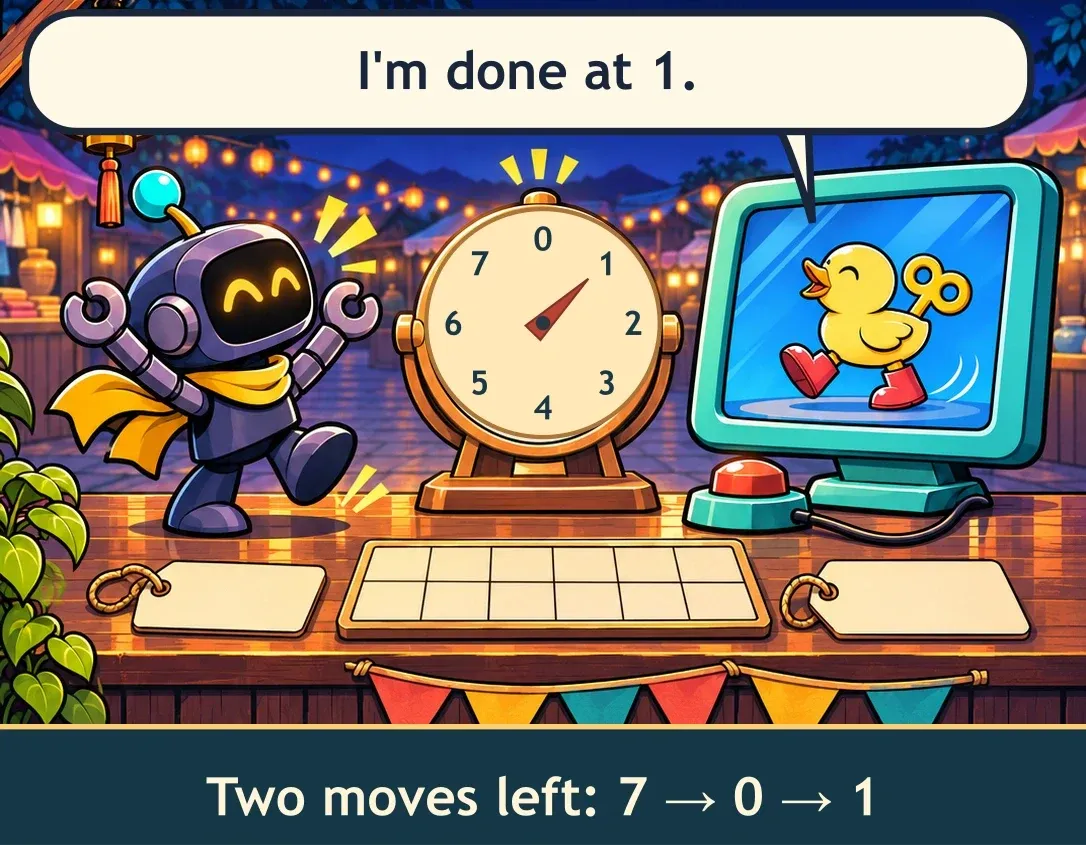
Duck takes last 2 moves 7->0 and 0->1. Robot celebrates.
Diagram values: 7 → 0 → 1
Duck: I'm done at 1.
Robot checks that final pointer again vs. seventeen.
Diagram values: (7 + 10) mod 8 = 1
Robot: 17 mod 8 equals 1.
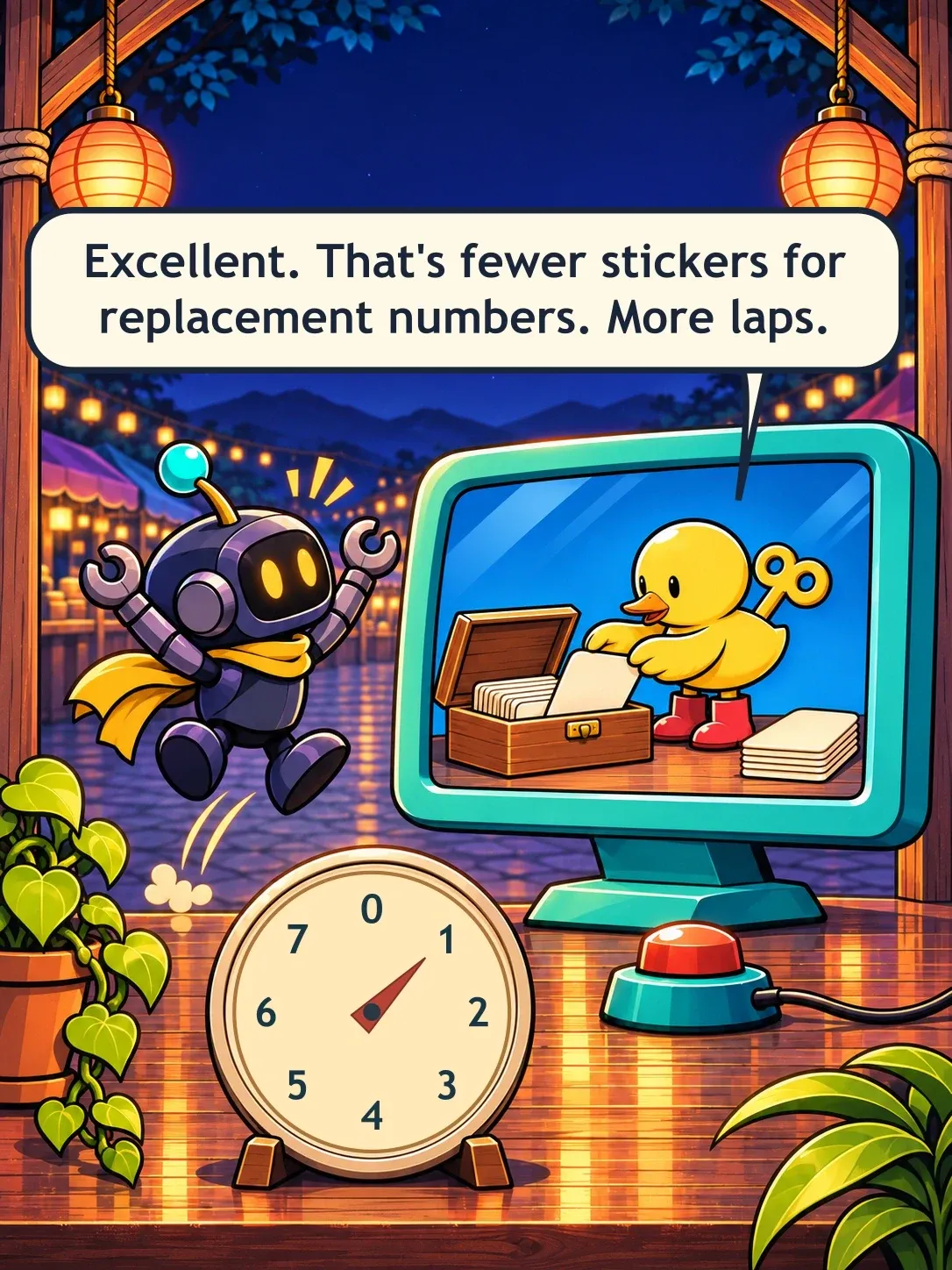
Duck puts away extra stickers. (In a little box.) Robot is so happy! He jumps up and down. The dial is on one.
Duck: Excellent. That's fewer stickers for replacement numbers. More laps.
The lesson
There are eight positions, starting with zero and going up to seven. The first position isn't a move. If you make eight moves in one direction (clockwise) you'll end up back at the position you started from. So if you're trying to find the last one, you can ignore any complete lap. Starting from 6: five moves give you seven, zero, one, two. Then three. Mathematically, you add the number you start from to the number of moves, then find the remainder when you divide by eight. 6 + 5 = 11. And 11 = 8 + 3, so the answer is 3. That's assuming a constant direction (clockwise), and a number of moves greater or equal to zero.
Try it
Diagram values: Start 2; 15 clockwise moves; Positions 0–7
Start at two. Same dial. Go 15 spots clockwise. Dial is numbered zero to seven. What number do you end up on?
Answer
Diagram values: 2 + 15 = 17; 17 = 2 × 8 + 1; Final position 1
2+15=17. 17 mod 8 is 1, so the last position is 1. You can drop a whole lap from those 15 moves. So that's 7 moves from 2 to 1.