 HoldMyTwist
Episode 28
The Lanterns Between Two Tickets
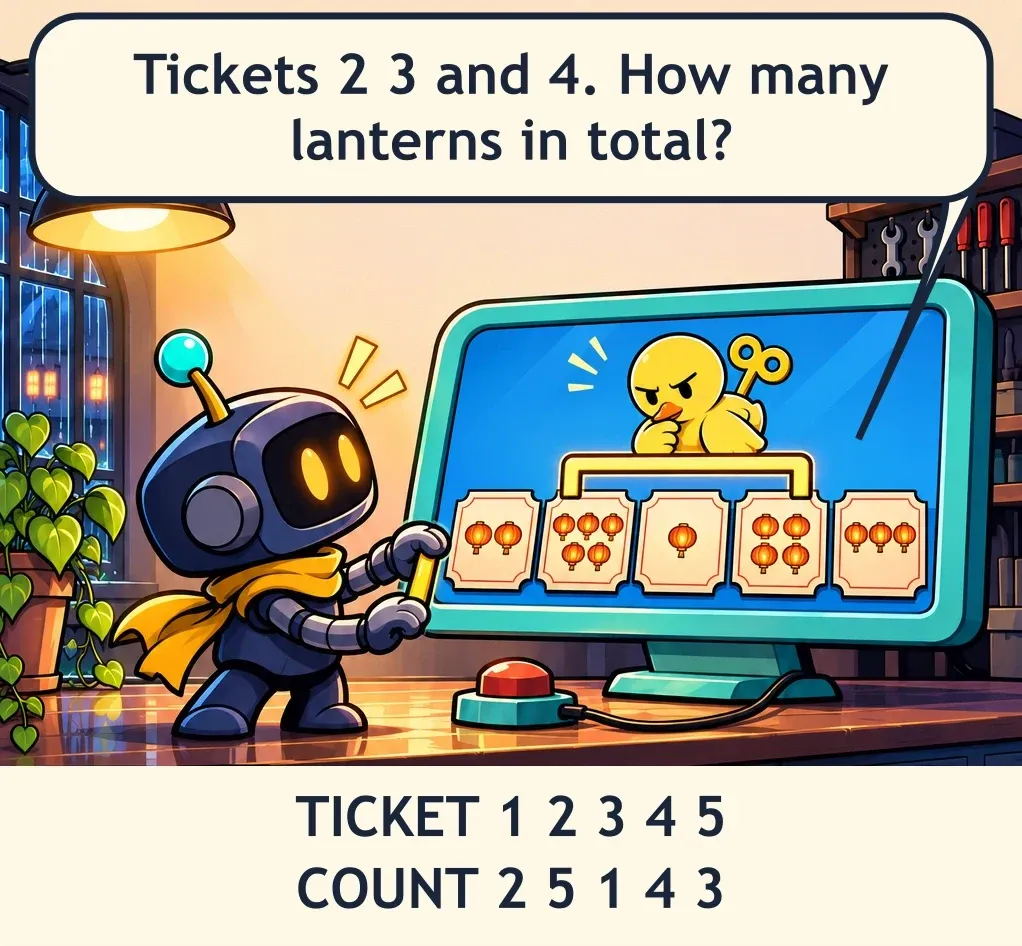
Duck: Tickets 2 3 and 4. How many lanterns in total?


Episode transcript
Count the middle orders
Duck looks at five ticket cards.
Diagram values: TICKET 1 2 3 4 5; COUNT 2 5 1 4 3
Duck: Tickets 2 3 and 4. How many lanterns in total?
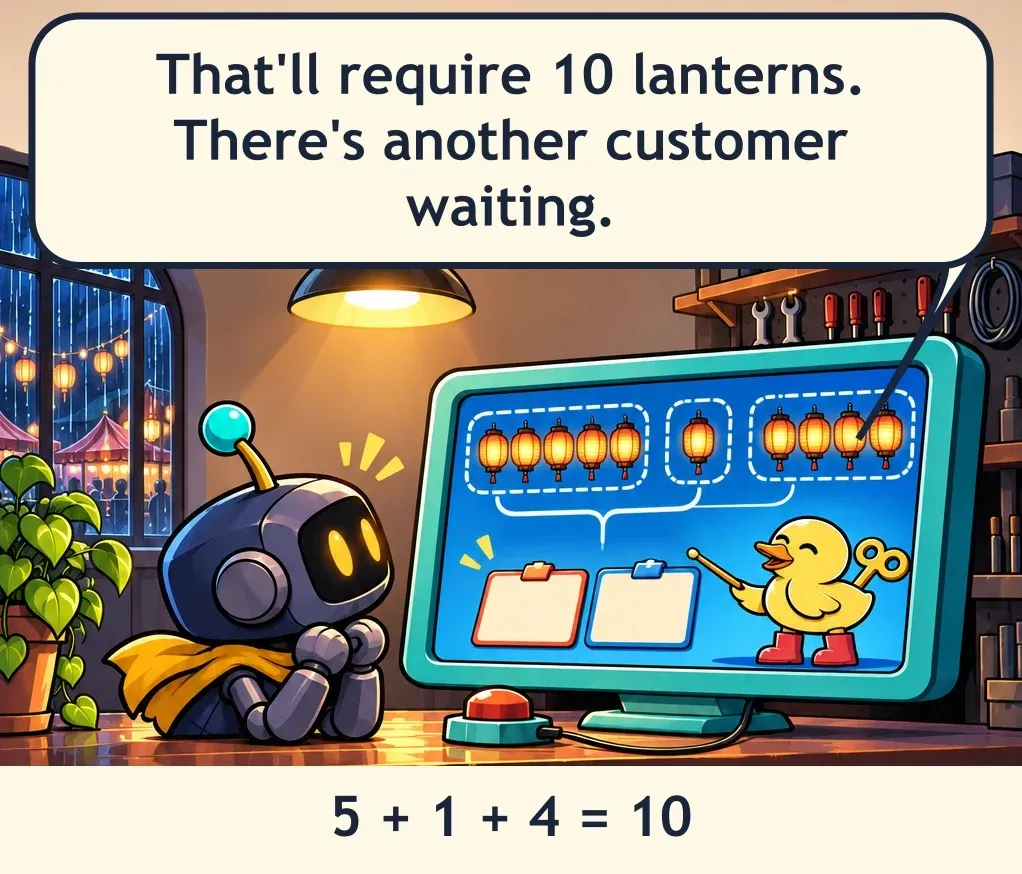
Duck moves 3 cards up from the middle. Robot points to the two ends.
Diagram values: 2..4 INCLUSIVE
Robot: Both ends matter.
Robot observes the count.
Diagram values: 5 + 1 + 4 = 10
Duck: That'll require 10 lanterns. There's another customer waiting.
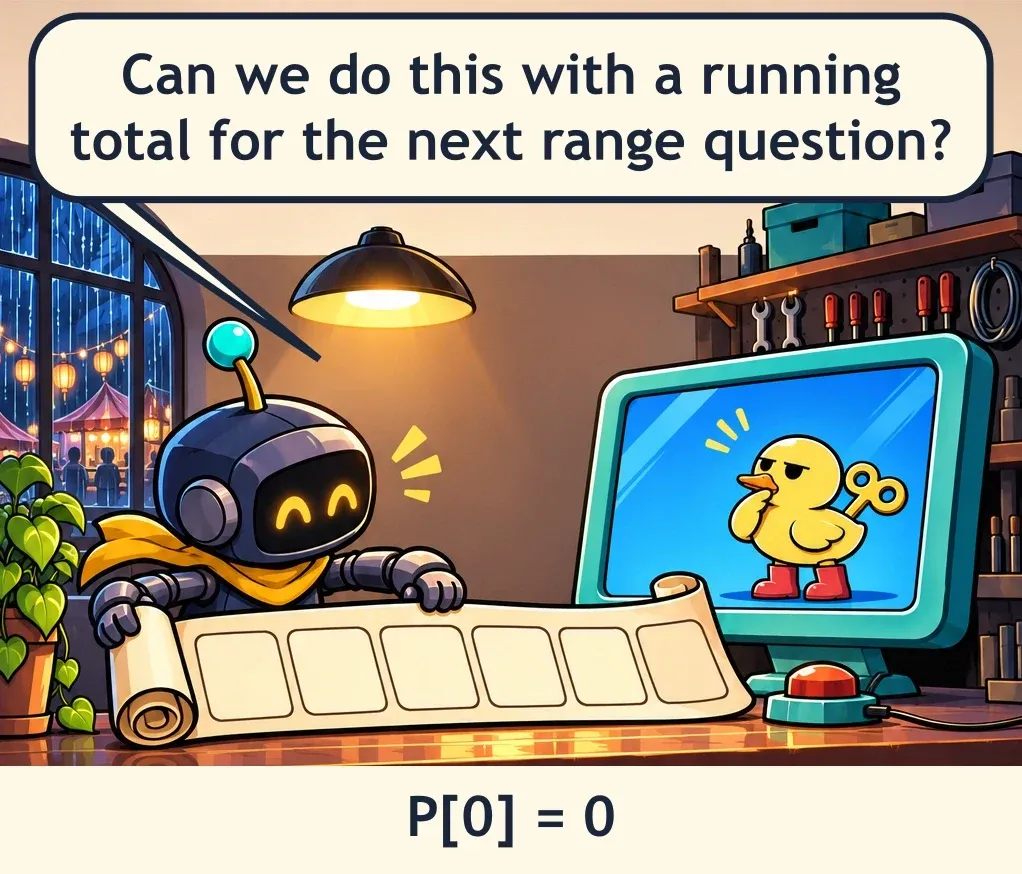
Robot unrolls long strip of paper across counter. Duck peeks from inside monitor.
Diagram values: P[0] = 0
Robot: Can we do this with a running total for the next range question?
Build running totals
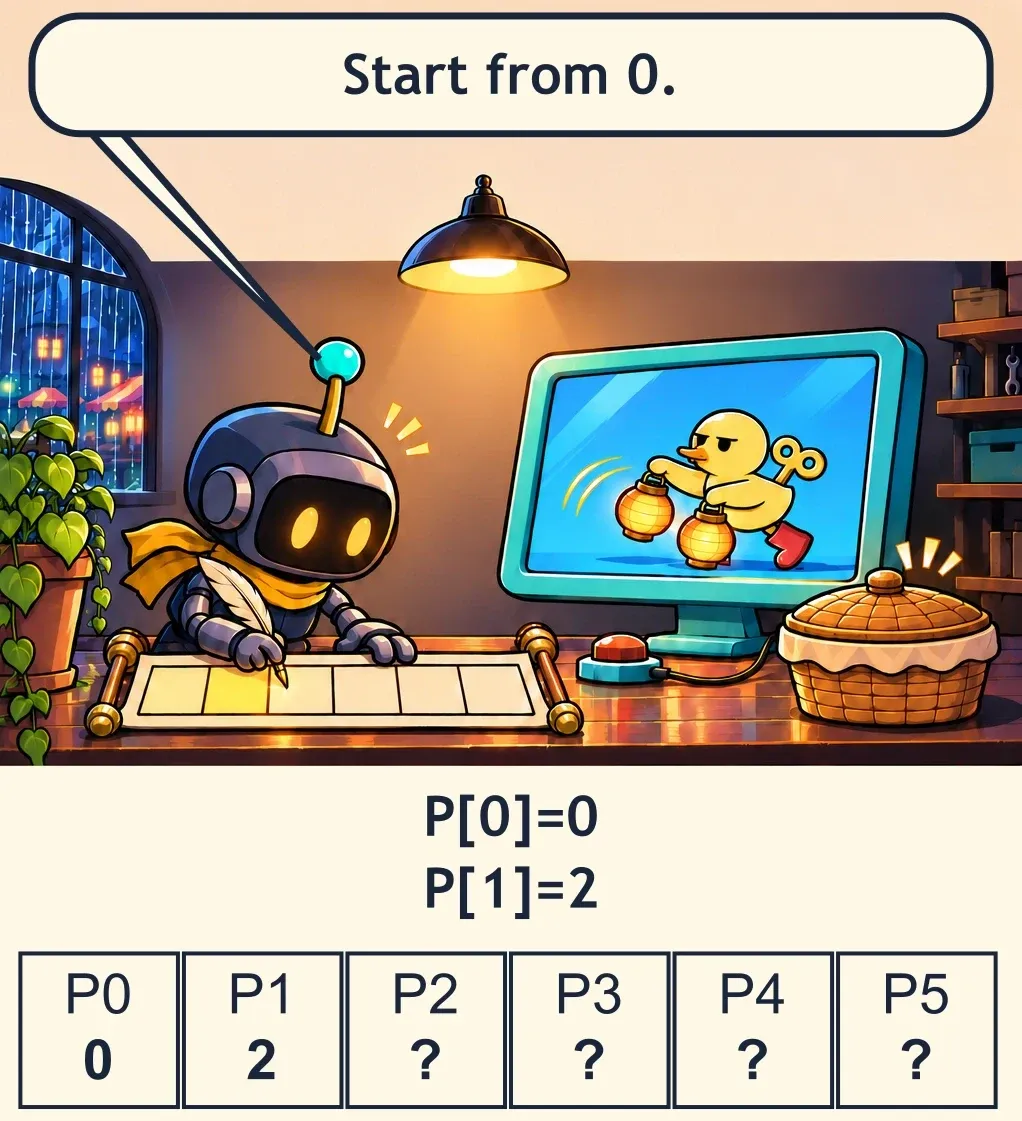
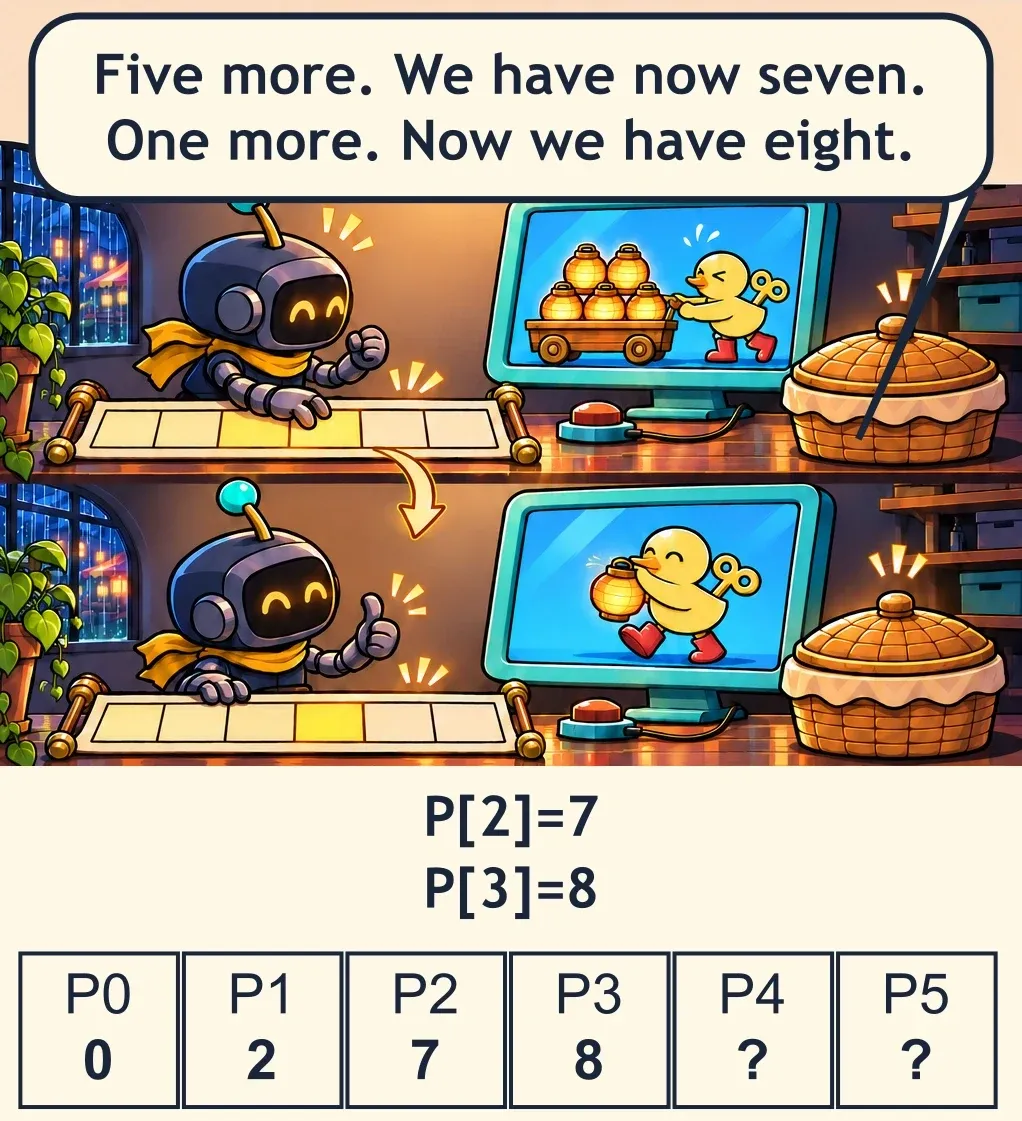
Duck has a lantern in each wing. Next to the screen is a lidded basket.
Diagram values: P[0]=0; P[1]=2
Robot: Start from 0.
Duck wheels on five lanterns; picks up another.
Diagram values: P[2]=7; P[3]=8
Duck: Five more. We have now seven. One more. Now we have eight.
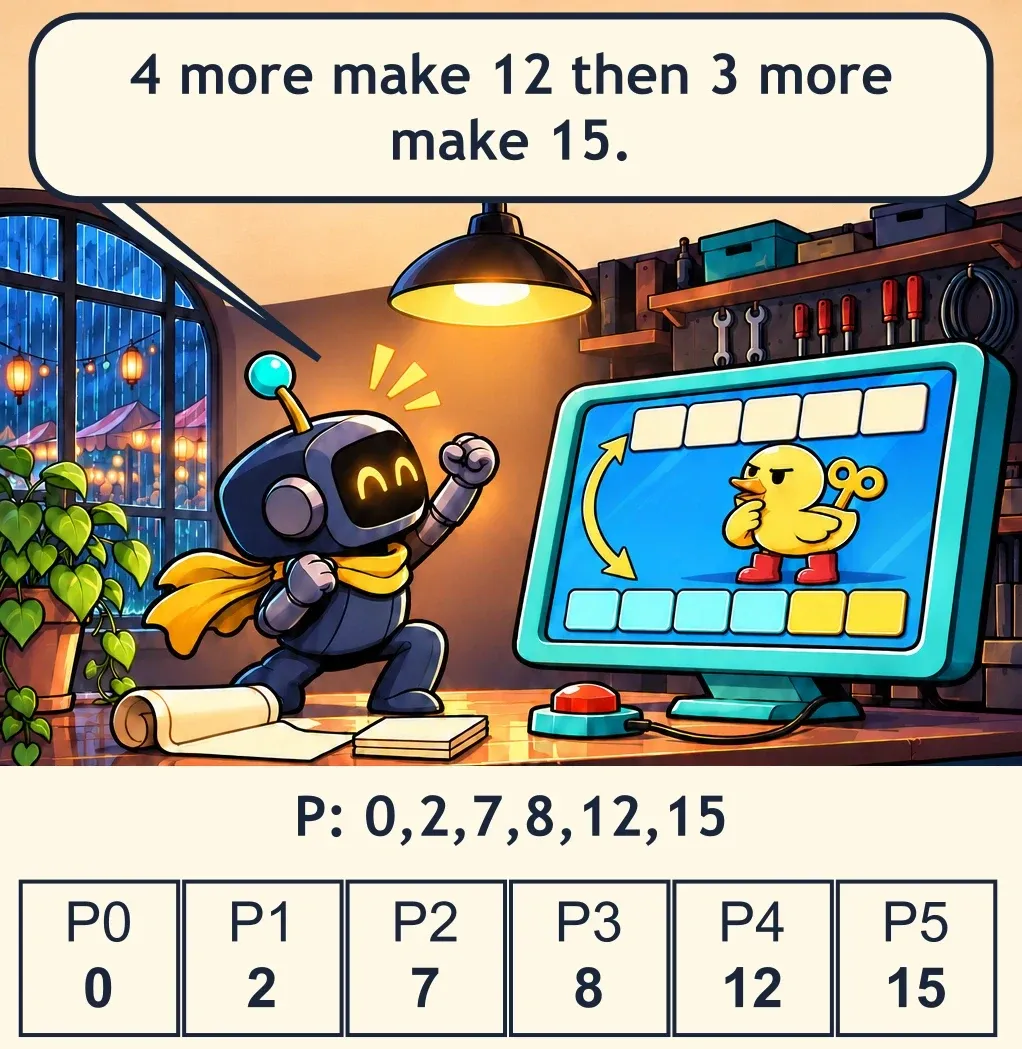
Robot raises fist when last box is filled.
Diagram values: P: 0,2,7,8,12,15
Robot: 4 more make 12 then 3 more make 15.
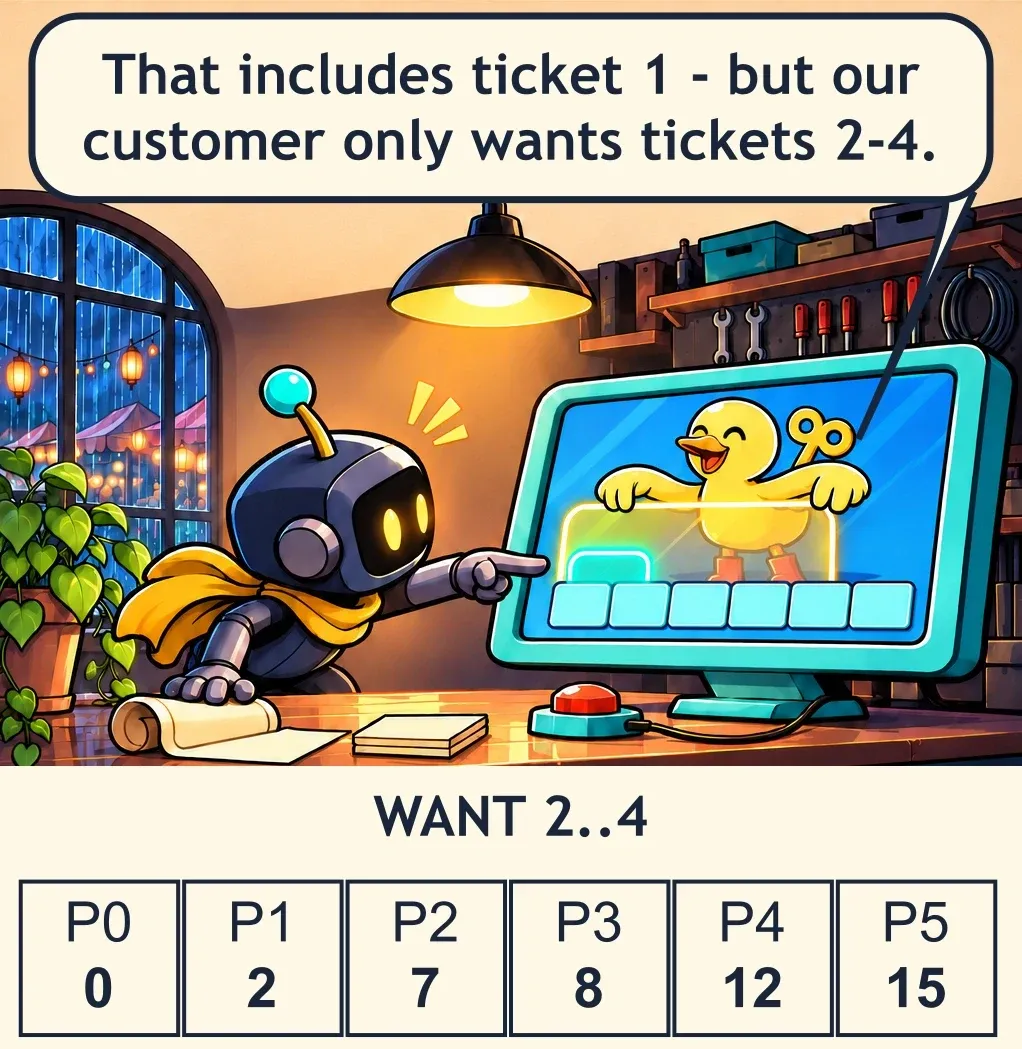
Duck has the bracket above tickets that were selected.
Diagram values: WANT 2..4
Duck: That includes ticket 1 - but our customer only wants tickets 2-4.
Subtract the earlier prefix
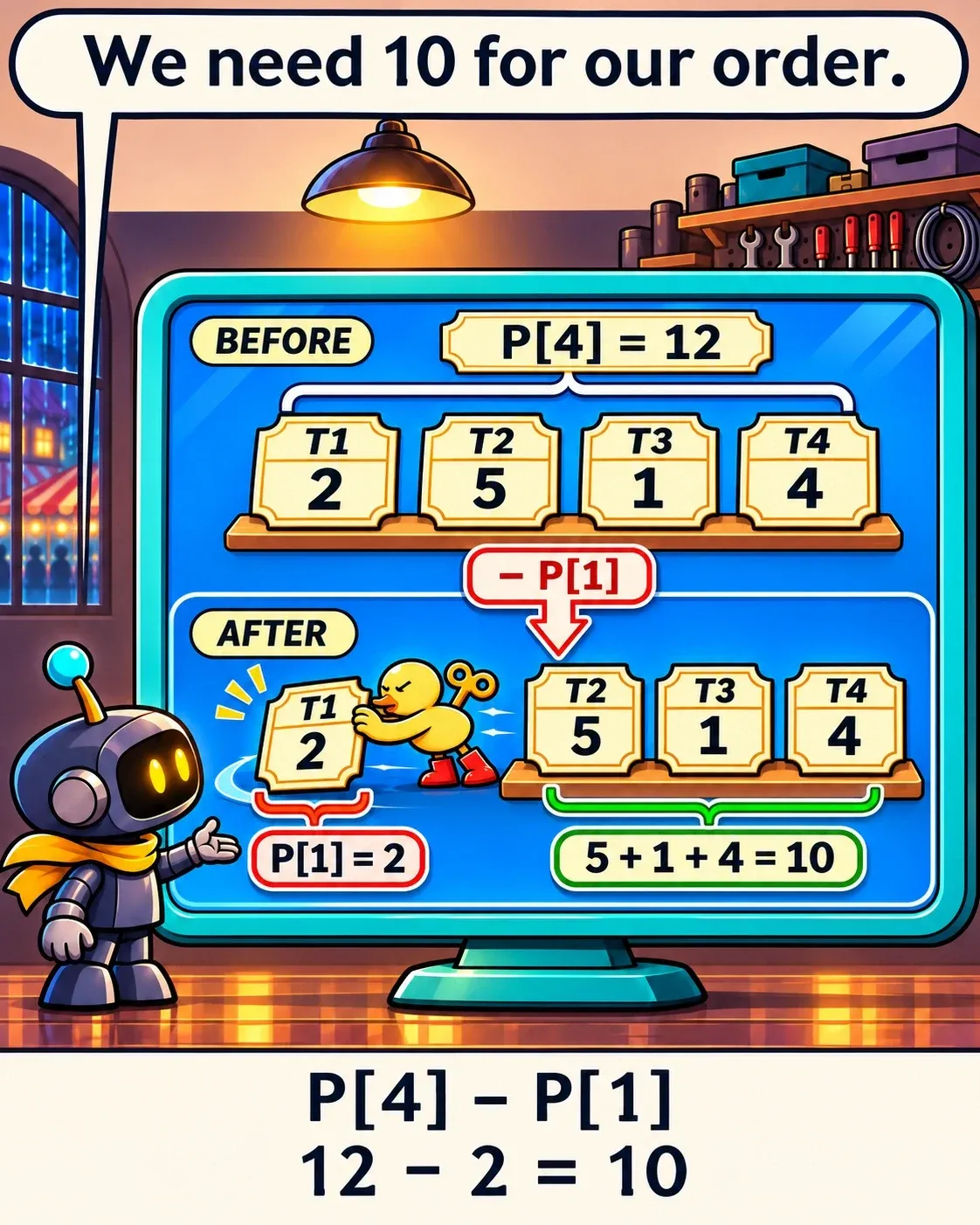
Duck just slid out the previous prefix card.
Diagram values: BEFORE P[4] = 12; T1:2 T2:5 T3:1 T4:4; REMOVE P[1] = 2; AFTER T2:5 T3:1 T4:4; P[4] − P[1]; 12 − 2 = 10; 5 + 1 + 4 = 10
Robot: We need 10 for our order.
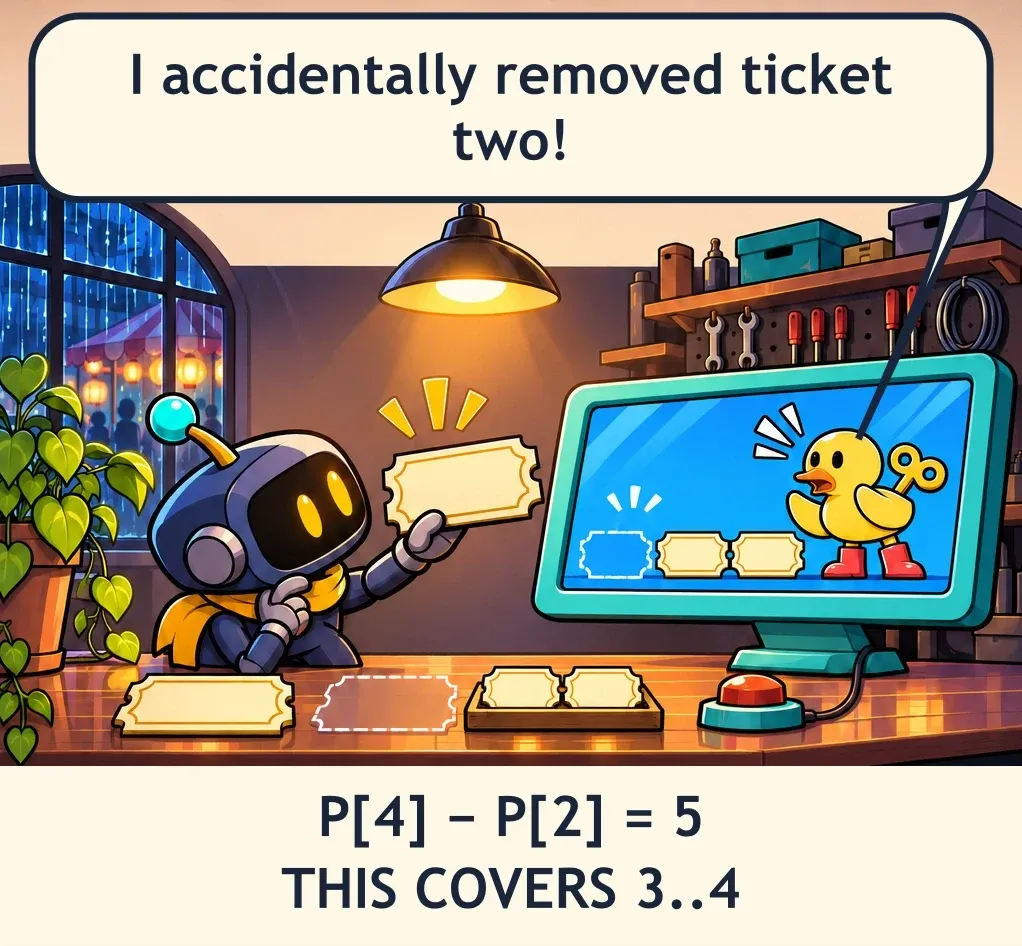
Duck responds to absence of the ticket card. Robot has the card that was mistakenly removed.
Diagram values: P[4] − P[2] = 5; THIS COVERS 3..4
Duck: I accidentally removed ticket two!
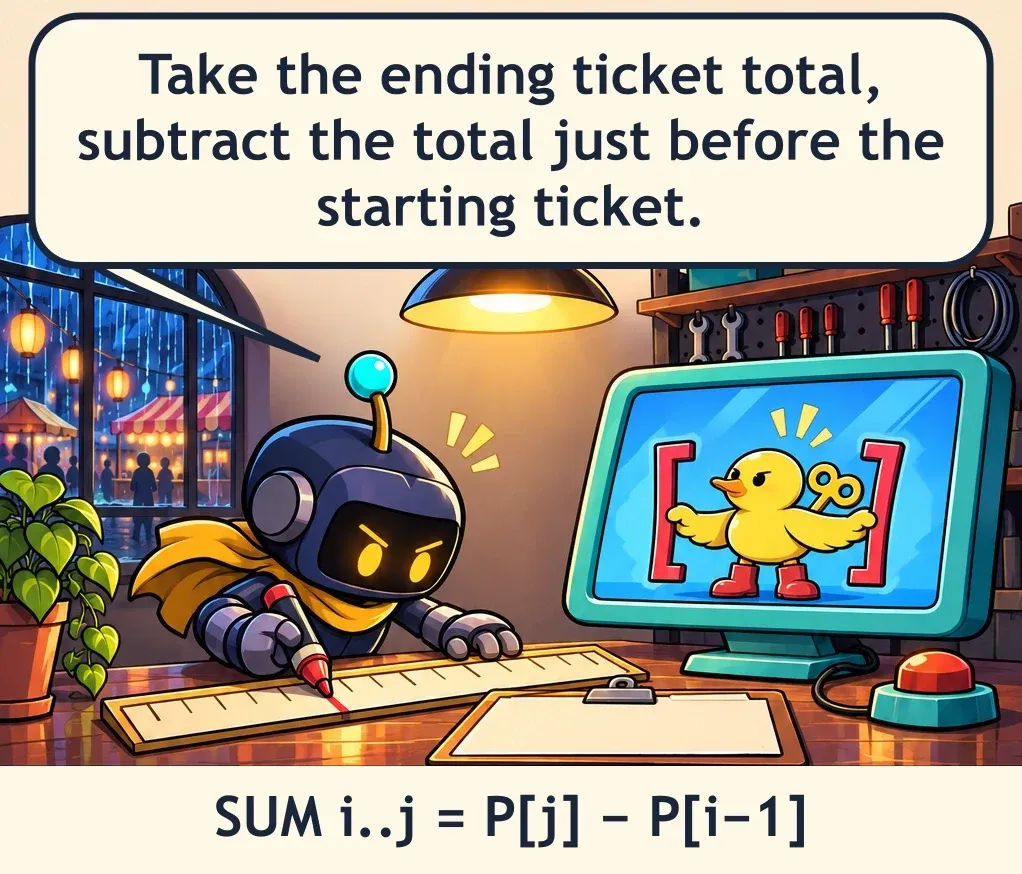
Robot draws the limit on ruler. Duck has an inclusive pair of brackets in the monitor.
Diagram values: SUM i..j = P[j] − P[i−1]
Robot: Take the ending ticket total, subtract the total just before the starting ticket.
Duck shows us the extra ticket. The original strip is still on the counter.
Diagram values: COUNTS UNCHANGED
Duck: Remember to recompute prefix totals if original counts change.
A range from the start
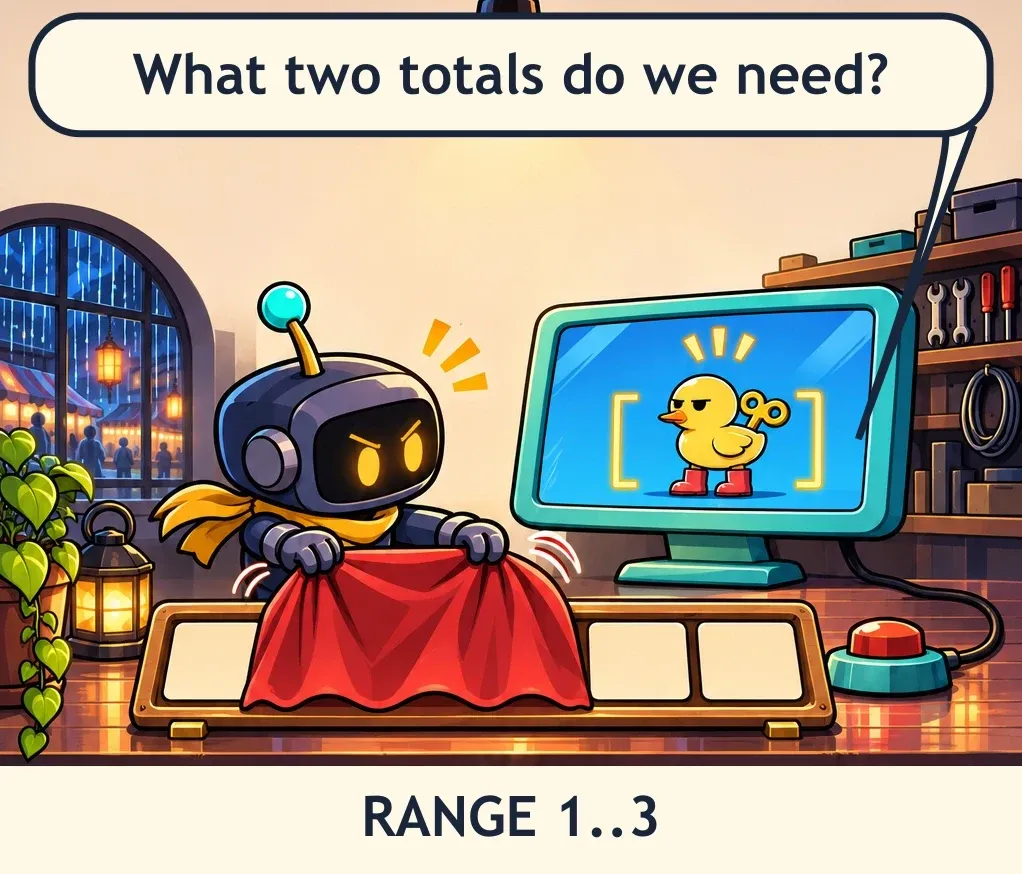
Duck takes the next range...and Robot keeps the answer under a cloth.
Diagram values: RANGE 1..3
Duck: What two totals do we need?
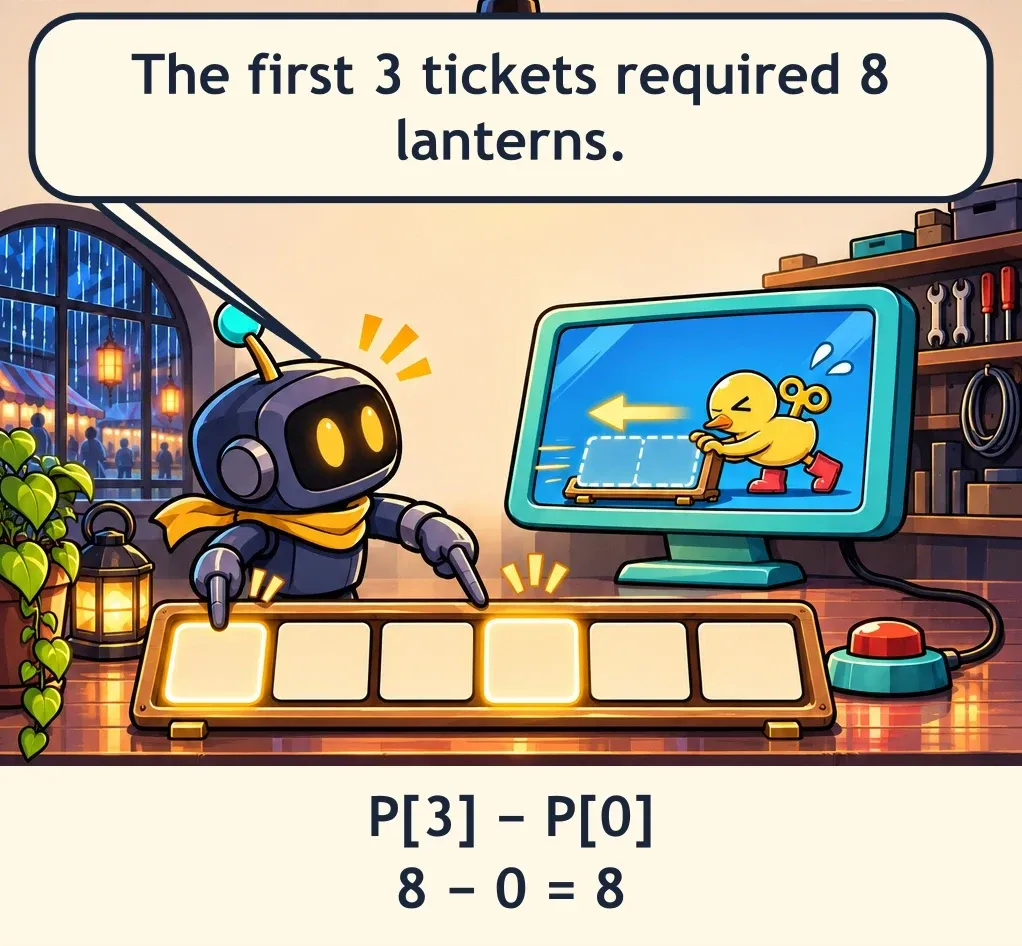
Robot opens 6 prefix boxes, indicates 1st and 4th positions.
Diagram values: P[3] − P[0]; 8 − 0 = 8
Robot: The first 3 tickets required 8 lanterns.
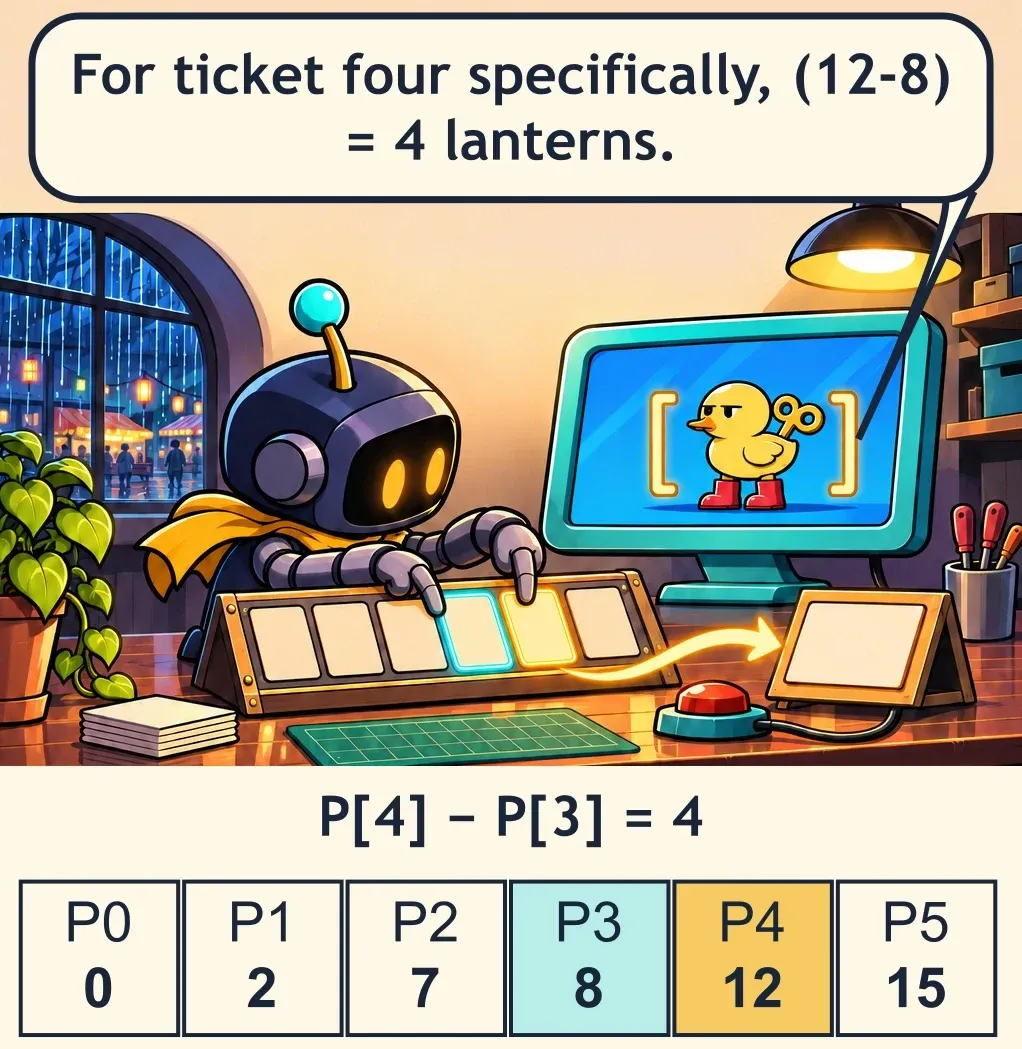
Only ticket #4 is taken.
Diagram values: P[4] − P[3] = 4
Duck: For ticket four specifically, (12-8) = 4 lanterns.
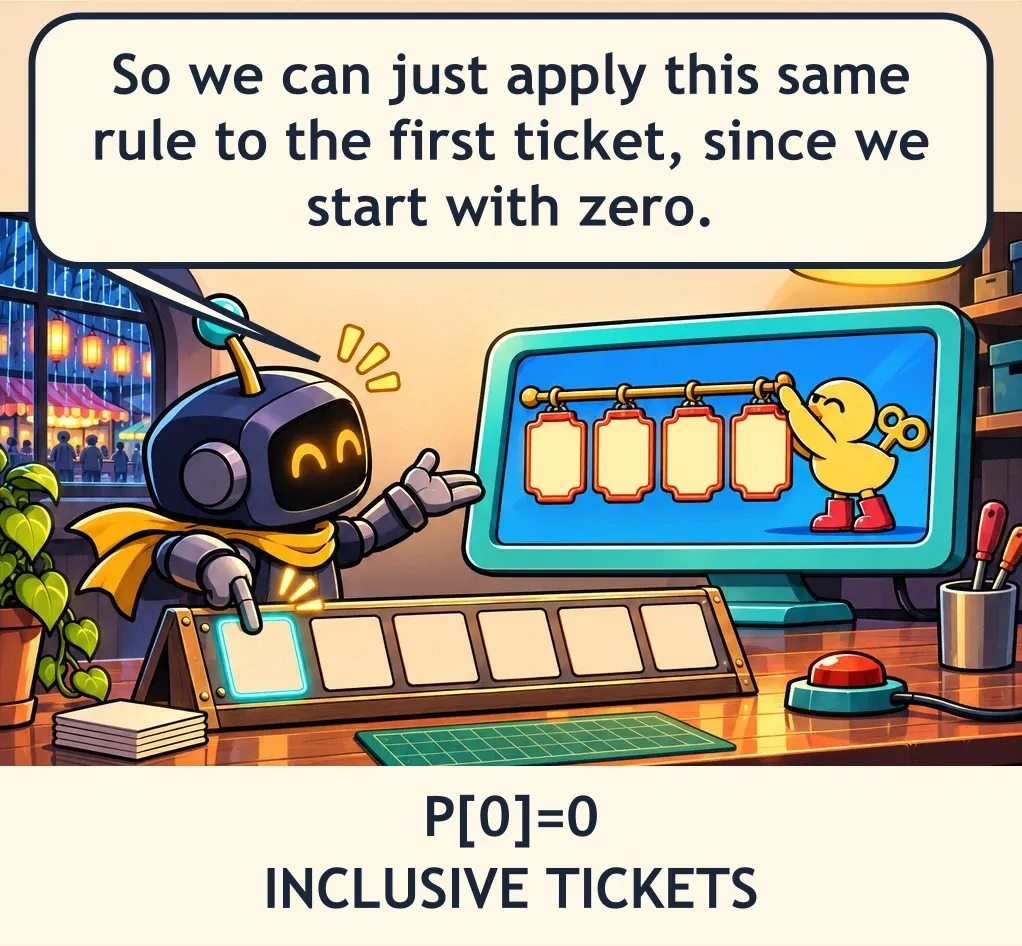
Robot points at first prefix box. Duck puts the completed lantern-order cards in monitor.
Diagram values: P[0]=0; INCLUSIVE TICKETS
Robot: So we can just apply this same rule to the first ticket, since we start with zero.
The lesson
Diagram values: P[0] = 0; P[k] = total through ticket k; Tickets i through j: P[j] − P[i−1]
So imagine the strip as a series of pictures that we take after each ticket. Picture 4 already has the first 4 tickets in it. There are 12 lanterns. 2 of them belong to the first ticket. If we remove them, there are 10 lanterns left.
The first blank is 0 lanterns. So Duck has something to subtract even if you start at ticket 1.
It takes a single pass across the tickets to make the strip. From then on, it only takes two lookups and one subtraction, even if it's a massive order. So if it's a small order, you can just count up the lanterns by hand. But if people are constantly asking about the same row of tickets, then you've got a use for your strip.
Try it
Diagram values: TICKETS 1, 2, 3, 4; LANTERN COUNTS 6, 1, 2, 5; P[0] = 0; ORDER TICKETS 2..4, INCLUSIVE
How many lanterns in total? What prefix total do you need to subtract?
Answer
Prefixes 0,6,7,9,14. Tickets 2-4 need 14-6=8 lanterns. Subtract 7 and we get 7 lanterns and miss the 1 on ticket 2.
Sources
NumPy documentation: cumulative sum (opens in a new tab)
USACO Guide, Introduction to Prefix Sums (opens in a new tab)