 HoldMyTwist
Episode 32
The Wheel Between Snapshots
Duck: My snapshot album claims the wheel did not turn. Robot: Could the wheel complete one round in between the pictures?












Episode transcript
An apparently still wheel
Duck looks at 3 different pics of the same marked wheel at 0, 1, 2 seconds. In each pic, the only arrow it has is one radial arrow which is pointing up.
Diagram values: t 0,1,2 s; ANGLES 0,0,0°
Duck: My snapshot album claims the wheel did not turn.
Robot points at the timer for a single shot per second. Duck lines up the 3 pics without moving the arrows.
Diagram values: SAMPLE EVERY 1 s
Robot: It takes one photo every single second.
The snapshots are the same, but the in-between might be different.
Diagram values: 0 TURNS/s ?
Duck: Maybe it's stopped at last. My camera is so convincing.
Robot makes full revolution in a 1 second gap. Duck stops to guess if the next photo might still have arrow up.
Diagram values: 1 TURN / s ?
Robot: Could the wheel complete one round in between the pictures?
Look between the clicks
Duck rotates wheel through a whole revolution clockwise. Arrow goes up again after going right, down and left.
Diagram values: 0→90→180→270→360°
Duck: It's a single round back to the top.
Robot demonstrates individual wheel rotating at two full rotations per second. Duck is comparing the last up-arrow to the first wheel.
Diagram values: 2 TURNS / s; ANGLE 0° AT 1 s
Robot: Two turns a second will snap you back to the same angle that was photographed.
Duck compares photos strips of still wheel, 1tps and 2tps wheels. All photos with integer seconds - arrow up.
Diagram values: 0/s → 0,0,0; 1/s → 0,0,0; 2/s → 0,0,0
Duck: All 3 look the same in the pics.
Robot is capturing identical samples; Duck is pointing out the difference in possible movement.
Diagram values: SAME SAMPLES
Robot: Different repeating motions give the same samples.
Take more snapshots
Duck switches camera mode to snap one picture every 1/4 second. Two test wheels known to spin at 1 tps and 2 tps start with arrow up.
Diagram values: 0,0.25,0.5,0.75,1 s
Duck: Let's try four times a second.
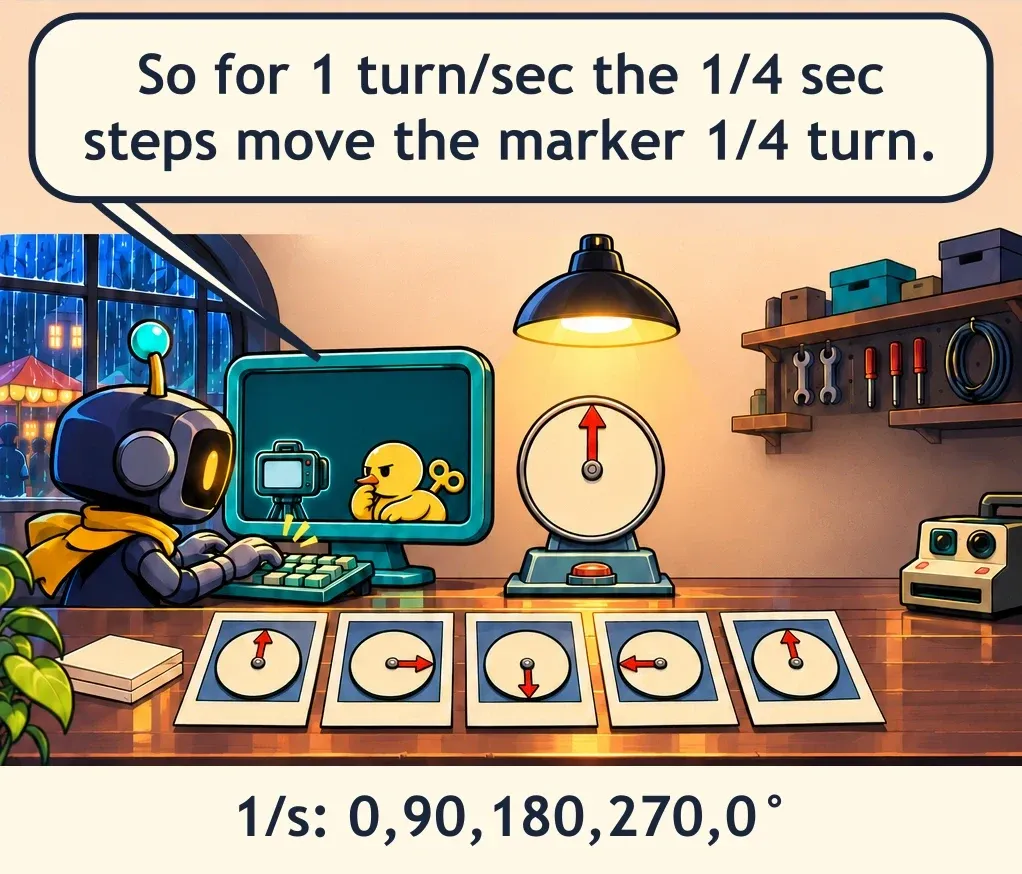
Duck matches it to quarter second times.
Diagram values: 1/s: 0,90,180,270,0°
Robot: So for 1 turn/sec the 1/4 sec steps move the marker 1/4 turn.
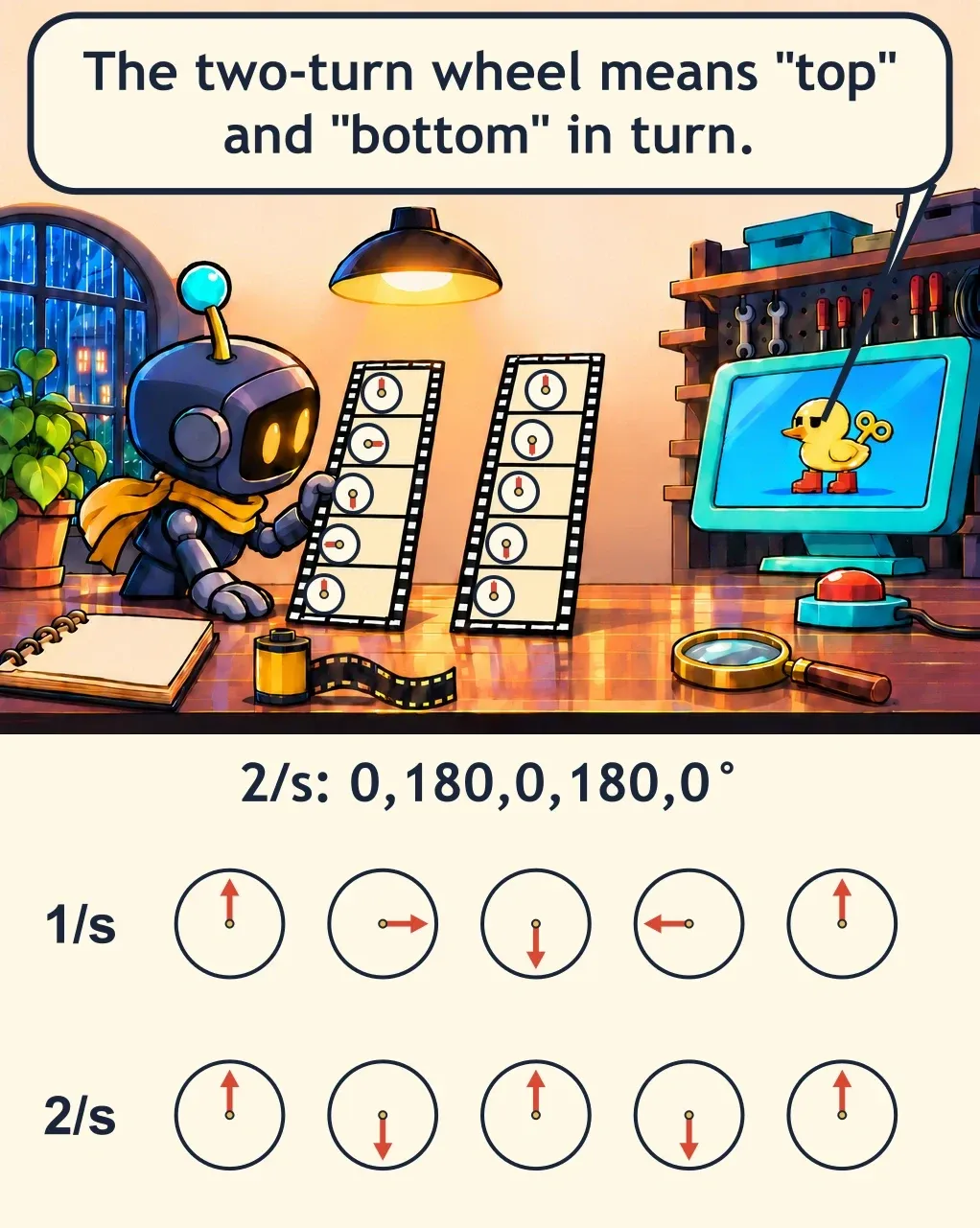
Duck shows you photos that taken with 2 turns per second. Up, down, up, down, up. Robot checks this strip against one-turn strip.
Diagram values: 2/s: 0,180,0,180,0°
Duck: The two-turn wheel means "top" and "bottom" in turn.
Duck keeps the two known rates marked but doesn't assert that any rate can be differentiated.
Diagram values: DISTINGUISH THIS PAIR
Robot: It doesn't catch all motions.
Another hidden spin
Duck has an individual wheel running, and it's doing 3 full rotations a second. Robot is the old 1 second camera schedule (prior to prediction).
Diagram values: 3 TURNS / s; SAMPLE EVERY 1 s
Duck: New wheel. Rotating at three revolutions per second. What does the old one second camera see?
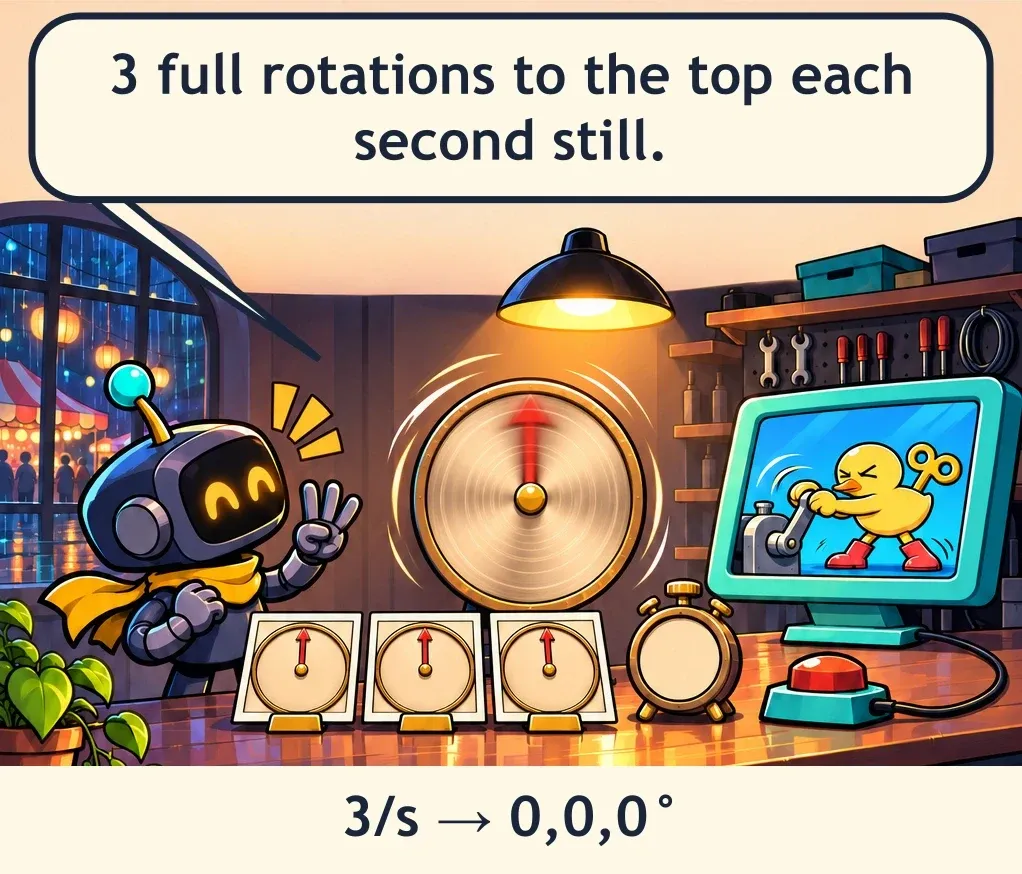
Duck is rotating the wheel through three full rotations per second. All the photos at 0, 1 and 2 seconds show the arrow up.
Diagram values: 3/s → 0,0,0°
Robot: 3 full rotations to the top each second still.
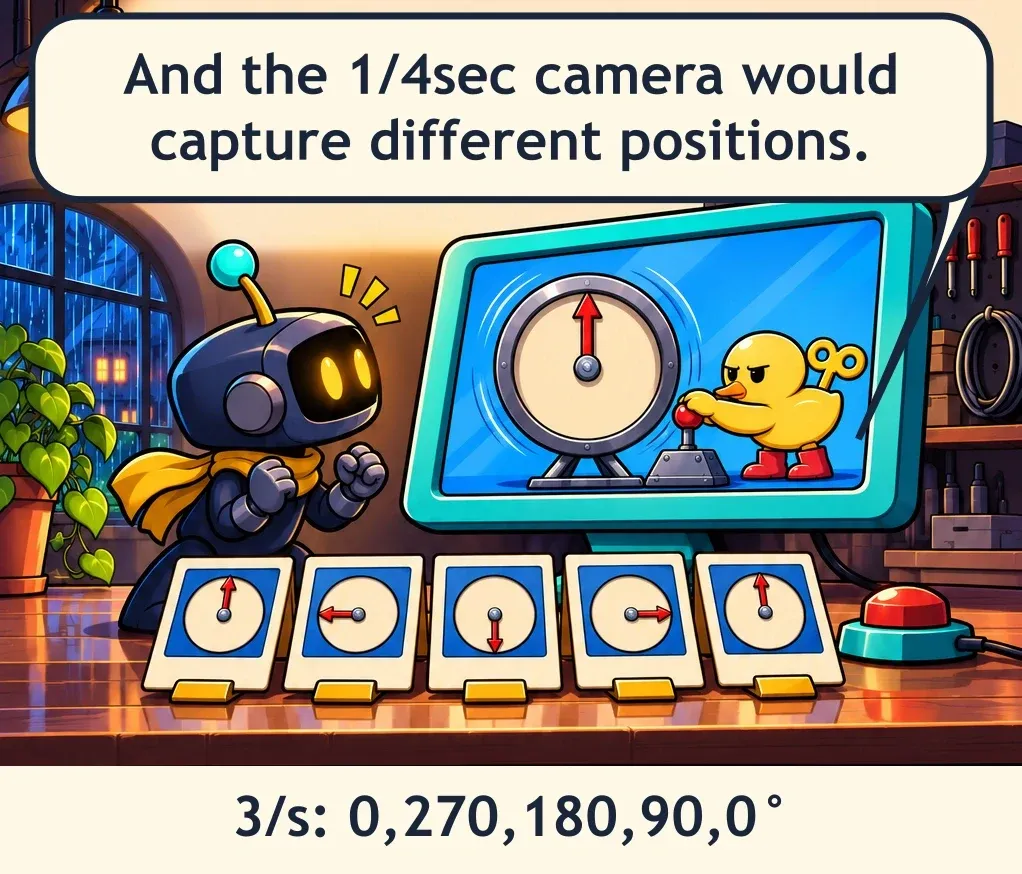
At 0 seconds, quarter, half, three-quarter, and 1 second the three-per-second wheel points up, left, down, right, and up.
Diagram values: 3/s: 0,270,180,90,0°
Duck: And the 1/4sec camera would capture different positions.
Duck labels both strips of photo with the exact time of sampling. Robot indicates the invisible motion in between slower snapshots.
Diagram values: TIMES MATTER; NO UNIQUE RATE FROM SLOW STRIP
Robot: Write down when samples were taken
The lesson
The camera tracks the location of the marker at the time of each photo. It doesn't track the motion between photos. Our wheels begin with the marker pointing up, and rotate at a constant speed. If we're taking one photo per second, then there's no difference to the photos between a wheel that's stopped and wheels rotating once or twice or three times per second. In all cases the photos show the marker pointing up. If we take a photo every 1/4 second, we can tell the difference between the one rotation and two rotation cases shown here. In the one rotation case, you get up, right, down, left, up. In the two rotation case you get up, down, up, down, up. The photos at higher frequency make us able to tell apart these specific speeds. But the photos don't tell us everything about all possible motion. We need to know what the sample times are and what motions are possible. If different motions produce the same samples, that's called aliasing.
Try it
Diagram values: RATES 0.5 AND 1.5 TURNS/s; TIMES 0,1,2 s; EXTRA PHOTO t=0.5 s
Two wheels pointing upwards begin uniform rotation clockwise. One is half turn per second. The other is one and a half turns per second. Compare marker angle of the two at 0 seconds, 1 second and 2 seconds. Is it possible to tell them apart from these samples? Or if one added a photo at 0.5 seconds will it distinguish this particular pair that was given?
Answer
Both wheels have 0-180-0 degrees at 0, 1, 2 seconds, so can't tell from these. The halfturn/sec is 90 degrees clockwise from up at 1/2 second, and 1.5 turn/sec wheel is 270 degrees at 1/2 sec. That extra pic helps this particular pair, but not in general that they recover uniquely.